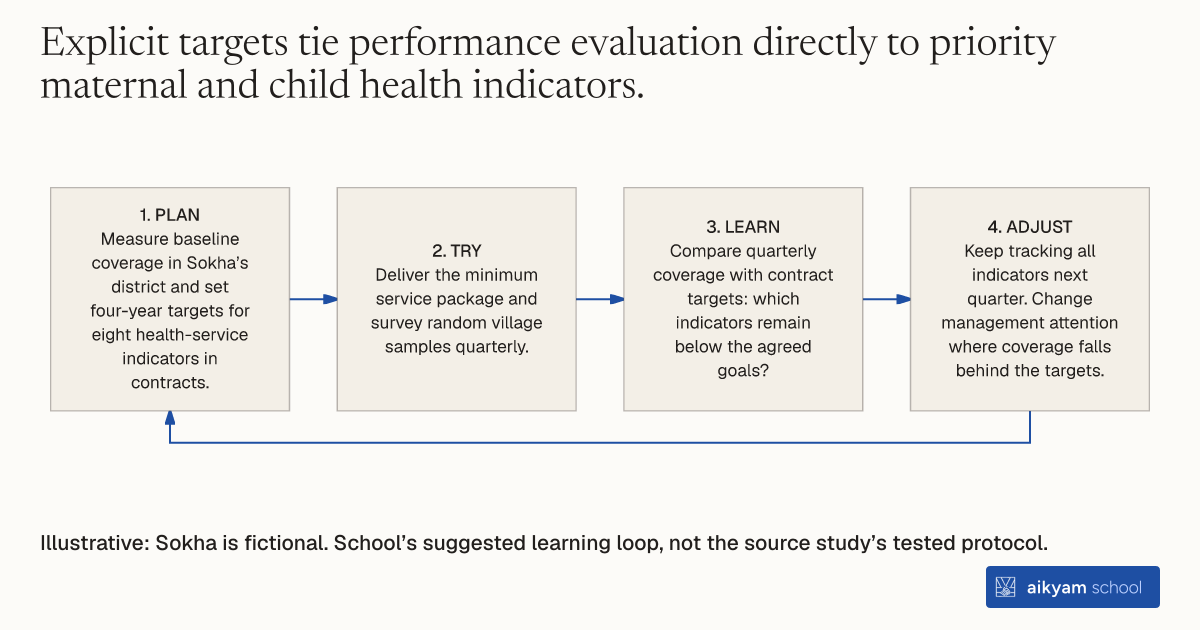
Try, learn and adjust
Check service coverage against contractual targets
- Plan: Measure baseline coverage in Sokha’s district and set four-year targets for eight health-service indicators in contracts.
- Try: Deliver the minimum service package and survey random village samples quarterly.
- Learn: Compare quarterly coverage with contract targets: which indicators remain below the agreed goals?
- Adjust: Keep tracking all indicators next quarter. Change management attention where coverage falls behind the targets.
Illustrative: Sokha is fictional. School’s suggested learning loop, not the source study’s tested protocol.
See source →School’s suggested, untested loop. Observe maternal and child health services, contraception knowledge and use, and public curative-care use. Targets are goals, not achieved outcomes.
How
When to use
Public health systems in developing countries often fail to deliver basic preventive care due to vague operational goals. Unfocused health facilities prioritize ad hoc curative demands over essential preventive services that generate broad public health benefits. Set explicit coverage targets for a standardized package of primary health services to focus facility management on priority outcomes.
Set explicit multi-year coverage targets for a standardized minimum package of primary health care services.
- Define the mandatory Minimum Package of Activities comprising all preventive, promotional, and simple curative services for district hospitals, health centers, and health posts.
- Measure baseline coverage levels across target populations for priority maternal and child health service indicators.
- Establish four-year quantitative coverage targets set between 160% and 450% of initial baseline levels.
- Include eight specific health service indicators: childhood immunization, vitamin A administration, antenatal care, delivery by a trained professional, delivery in a health facility, knowledge of birth control, use of birth control, and public facility use for curative care.
- Incorporate these explicit targets directly into health service management contracts.
- Survey random village samples quarterly to measure progress against the contractual targets.
Why it works
Focusing contractor management on contractually defined coverage goals prevents effort fragmentation and aligns facility operations with key public health priorities.
Example
The Cambodian Ministry of Health set explicit four-year goals for contractors across five rural health districts from 1999 to 2003. Goals required reaching 70% child immunization, 70% vitamin A coverage, 50% antenatal care, 50% trained deliveries, 10% facility deliveries, 30% modern contraception use, 70% contraception knowledge, and increased public facility use. Overall targeted health outcomes improved by 0.51 to 0.54 standard deviations over comparison districts.
About the study
Participants
12 rural districts across Takeo, Prey Veng, and Kampong Cham provinces in Cambodia, covering 1.26 million residents across 360 sample villages with 3,700 households and 143 health centers.
Study Design
Cluster-randomized trial evaluating 12 districts randomly assigned to contracting out, contracting in, or comparison status, using initial random eligibility as an instrumental variable for actual contract rollout.
Results
Setting explicit Minimum Package of Activities targets improved targeted health indicators by an average of 0.51 standard deviations in contracting-in districts and 0.54 standard deviations in contracting-out districts relative to comparison districts.