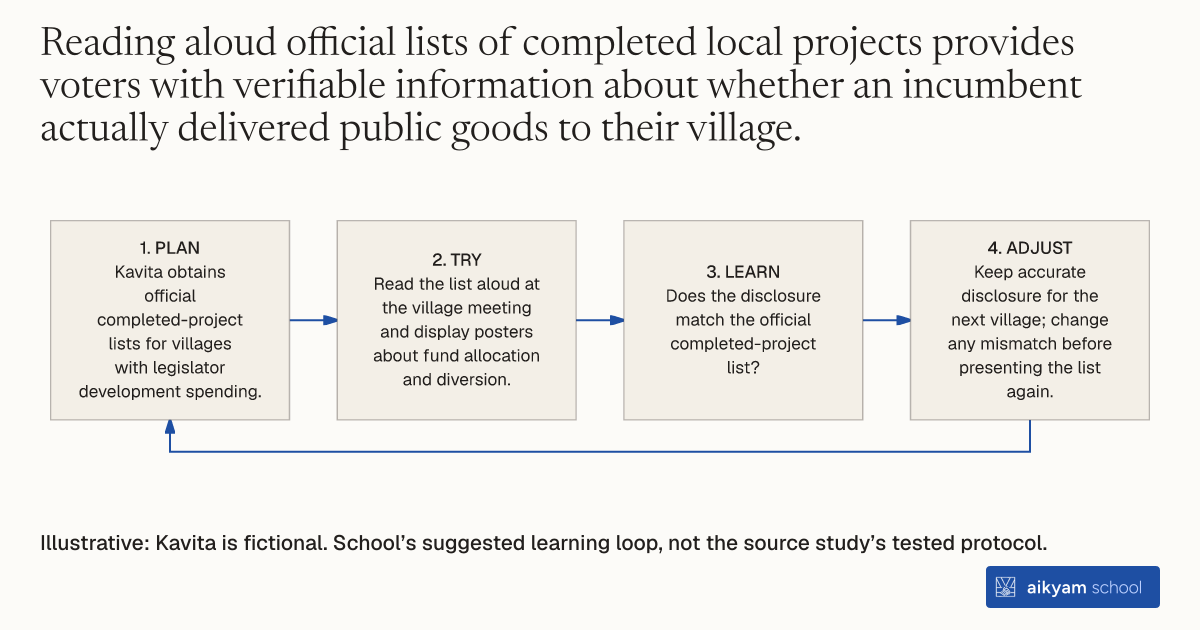
Try, learn and adjust
Check project disclosure matches official records
- Plan: Kavita obtains official completed-project lists for villages with legislator development spending.
- Try: Read the list aloud at the village meeting and display posters about fund allocation and diversion.
- Learn: Does the disclosure match the official completed-project list?
- Adjust: Keep accurate disclosure for the next village; change any mismatch before presenting the list again.
Illustrative: Kavita is fictional. School’s suggested learning loop, not the source study’s tested protocol.
See source →School’s suggested learning loop, not a tested source procedure. Observe official project lists and disclosed information; the study found no statistically significant turnout or vote-share change.
How
When to use
In developing democracies, incumbent legislators receive discretionary development funds to finance local infrastructure projects, but citizens often suspect these resources are misused. Publicly disclosing completed discretionary development projects in targeted villages gives voters verifiable spending records. This transparency allows rural citizens to evaluate incumbent performance based on concrete local deliveries rather than vague promises.
Disclose completed legislator development projects publicly in rural villages during a non-partisan voter campaign.
- Obtain official records of discretionary local area development projects funded by incumbent legislators across electoral constituencies.
- Identify and categorize target villages based on whether the incumbent reported spending discretionary funds in each location.
- Deploy campaign workers to villages with documented discretionary spending during pre-election mobilization drives.
- Read aloud the list of completed development projects to gathered residents during central village meetings.
- Display public posters illustrating how development funds are allocated and explaining how corrupt officials divert resources.
Why it works
Lowering information costs enables citizens to evaluate incumbent probity and performance against concrete community spending.
Example
During the 2007 Uttar Pradesh state assembly election, NGO field workers from Sarathi read aloud official MLA fund project lists across treated villages in 32 polling-station clusters. In villages where discretionary spending was disclosed, the intervention produced no statistically significant increase in turnout or candidate vote share shift compared to non-disclosure control villages.
About the study
Participants
The trial evaluated 32 polling-station clusters across 14 assembly constituencies in Lalitpur, Bahraich, and Sitapur districts of Uttar Pradesh, India, comparing electoral outcomes across treated and control polling units stratified by MLA fund spending.
Study Design
Researchers implemented a randomized cluster field experiment stratified by incumbent discretionary spending (MLA fund status), using instrumental variables to correct for village-unit selection rules and evaluating turnout and candidate vote shares from official Election Commission returns.
Results
Disclosing MLA fund projects yielded no statistically significant effect on voter registration or turnout (Treatment*MLA fund point estimate -0.152; p = 0.36), and produced no reduction in the vote share of candidates ranked most corrupt by journalists.