Research procedure
Describe the monetary-penalty game
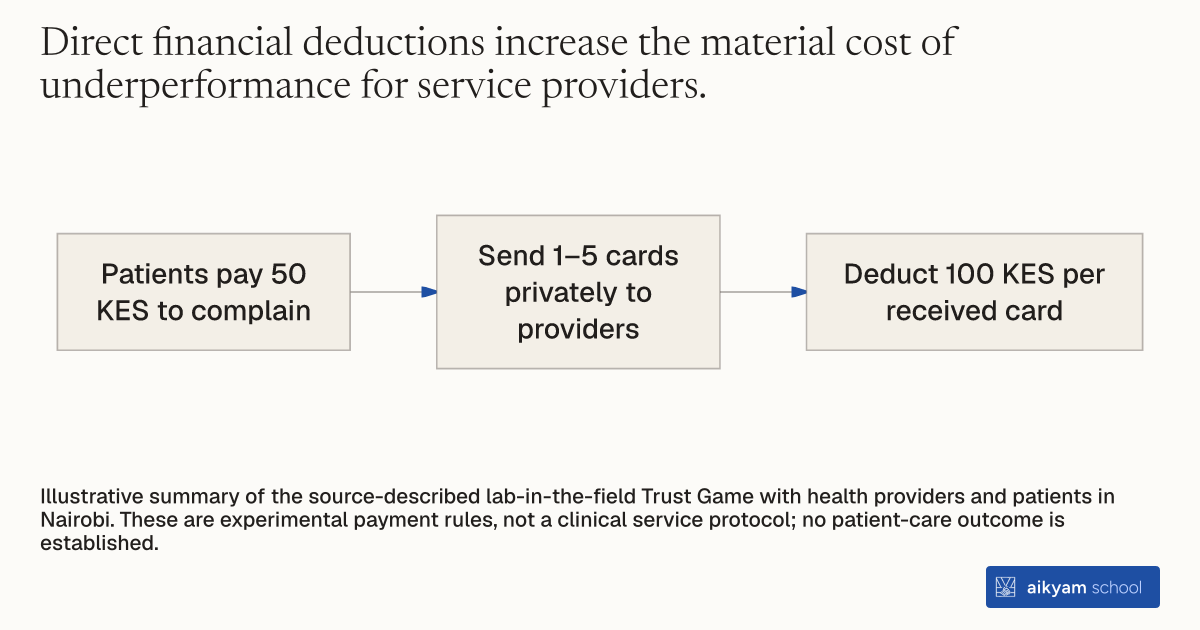
- Patients pay 50 KES to complain
- Send 1–5 cards privately to providers
- Deduct 100 KES per received card
Illustrative summary of the source-described lab-in-the-field Trust Game with health providers and patients in Nairobi. These are experimental payment rules, not a clinical service protocol; no patient-care outcome is established.
See source →How
When to use
Public health clinics in developing countries experience low provider effort and high absenteeism due to weak administrative monitoring. Top-down supervision is often ineffective or financially prohibitive to implement continuously. This formal financial mechanism deducts money directly from provider payouts based on verified patient complaints to incentivize prosocial provider behavior.
Deduct financial penalties from health provider earnings based on patient disapproval cards to force high service effort.
- Invite exiting facility patients to complete service evaluations and register grievances against assigned health providers.
- Require dissatisfied patients to pay a fixed reporting fee of 50 KES to submit complaint cards.
- Allow complaining patients to send between 1 and 5 frowning face disapproval cards per transaction to specify grievance severity.
- Deliver received complaint cards privately in sealed envelopes directly to individual health workers.
- Deduct a fixed monetary penalty of 100 KES per received complaint card directly from the health worker's final payment.
Why it works
Facing direct monetary losses for poor care forces providers to return more value to patients to prevent costly complaints.
Example
In Nairobi, Kenya, researchers tested this mechanism with 103 health providers and 216 patients across 93 public and private health facilities in a lab-in-the-field game. Charging providers 100 KES per complaint card increased provider returned-received ratios from a control mean of 1.039 to 1.365, representing a 33 percentage point increase in funds returned to patients.
About the study
Participants
103 health providers (77 public sector, 26 private sector) and 216 patients recruited from 93 health dispensaries and centers in Nairobi, Kenya.
Study Design
Lab-in-the-field experiment using strategy-elicited Trust Games comparing a Monetary Penalty treatment against a private Complaint Box control, evaluated via OLS regressions with wild cluster bootstrap standard errors.
Results
Monetary penalties increased provider reciprocity by 33 percentage points relative to the Complaint Box control (p = 0.036 wild bootstrap), increasing returned ratios by 32 percent over the control mean of 1.039.