Research procedure
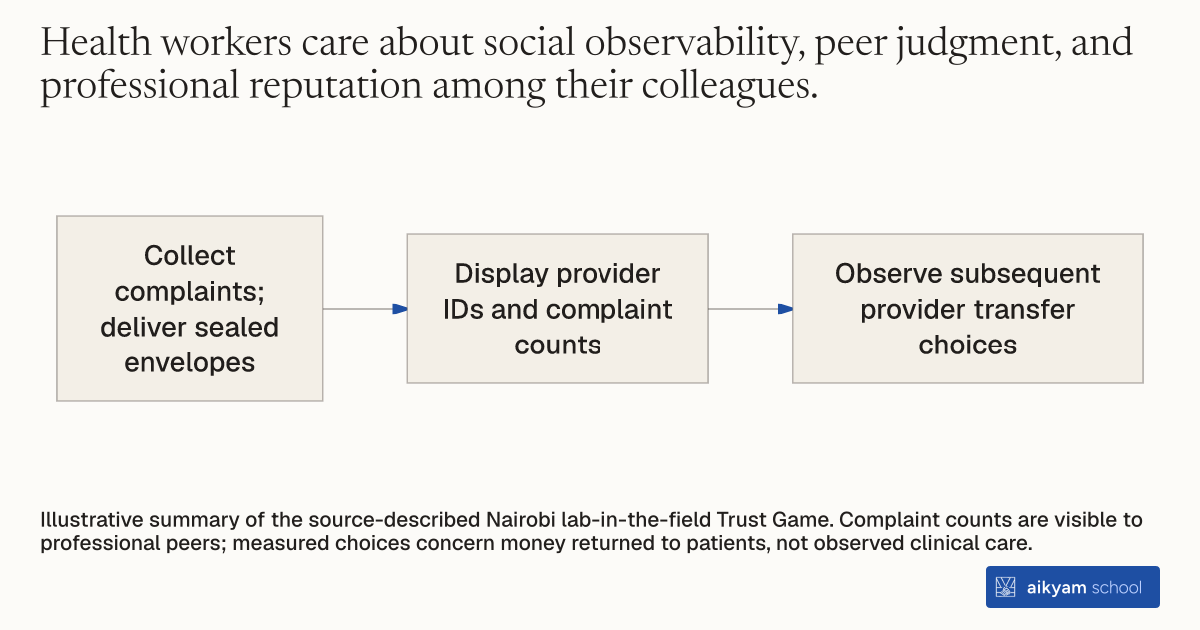
Describe peer disclosure in the game
- Collect complaints; deliver sealed envelopes
- Display provider IDs and complaint counts
- Observe subsequent provider transfer choices
Illustrative summary of the source-described Nairobi lab-in-the-field Trust Game. Complaint counts are visible to professional peers; measured choices concern money returned to patients, not observed clinical care.
See source →How
When to use
Public health clinics in developing countries face low health worker effort and high absence rates. Government monitoring is often too weak or costly to enforce worker discipline from the top down. This non-monetary mechanism uses peer oversight and social shaming to increase health provider effort toward patients.
Disclose patient complaint counts publicly to professional peers to motivate frontline health worker performance.
- Collect standardized complaints and frustration ratings from patients exiting health service encounters.
- Deliver complaints sealed in envelopes to health workers while recording total card counts per worker.
- Display each worker's identification number alongside their received complaint count on an internal bulletin board visible to all facility staff.
- Allow health workers to observe peer performance disclosures prior to delivering subsequent patient care decisions.
Why it works
Publicly displaying patient complaints generates non-monetary social costs that motivate providers to act prosocially without requiring cash fines.
Example
In Nairobi, Kenya, researchers tested this mechanism with 103 health providers and 216 patients across 93 health facilities in a lab-in-the-field game. Disclosing patient complaints on a shared blackboard raised provider reciprocity from a control average of 1.039 to 1.460, representing a 42 percentage point increase in funds returned to patients.
About the study
Participants
103 health providers (77 public, 26 private) and 216 patients recruited from 93 health centers and dispensaries in Nairobi, Kenya.
Study Design
Lab-in-the-field experiment using strategy-elicited Trust Games comparing a Peer Disclosure treatment against a private Complaint Box control, evaluated via OLS regressions with wild cluster bootstrap standard errors.
Results
Peer Disclosure increased health worker reciprocity by 42 percentage points over the Complaint Box control (p = 0.048), performing as effectively as a direct Monetary Penalty treatment which increased reciprocity by 33 percentage points.