Research procedure
Describe retaliation in the game
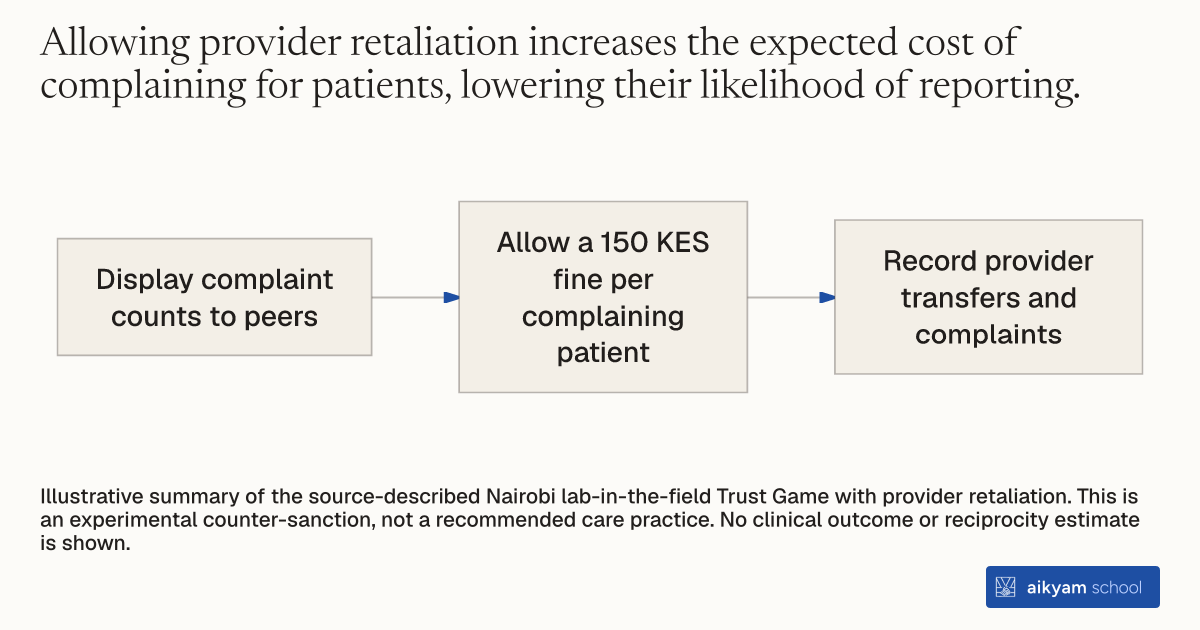
- Display complaint counts to peers
- Allow a 150 KES fine per complaining patient
- Record provider transfers and complaints
Illustrative summary of the source-described Nairobi lab-in-the-field Trust Game with provider retaliation. This is an experimental counter-sanction, not a recommended care practice. No clinical outcome or reciprocity estimate is shown.
See source →How
When to use
Public health clinics face low provider effort and high absenteeism in settings with weak state capacity. Bottom-up citizen reporting can suffer when providers have the power to punish complaining patients. This mechanism tests how allowing providers to retaliate against complaining patients affects provider effort and patient reporting.
Combine public peer disclosure of patient complaints with a provider retaliatory penalty to test accountability under threat of payback.
- Collect standardized complaints and frustration cards from patients exiting clinical care.
- Display received complaint counts per health worker on a shared board visible to professional peers.
- Allow health workers to impose a fixed monetary fine of 150 KES directly on any patient who files a complaint.
- Record provider returned transfers and patient complaint choices under the threat of provider counter-sanctions.
Why it works
Reduced reporting expectations weaken the pressure on providers to act prosocially, muting the positive performance effects of peer pressure.
Example
In Nairobi, Kenya, researchers tested this mechanism with 103 health providers and 216 patients across 93 health facilities in a lab-in-the-field game. Permitting providers to retaliate with a 150 KES penalty reduced the provider reciprocity gain from 42 percentage points down to 26 percentage points relative to the Complaint Box control.
About the study
Participants
103 health providers (77 public sector, 26 private sector) and 216 patients recruited from 93 health centers and dispensaries in Nairobi, Kenya.
Study Design
Lab-in-the-field experiment using strategy-elicited Trust Games comparing a Peer Disclosure with Retaliation treatment against Complaint Box control and standard Peer Disclosure, evaluated via OLS regressions with wild cluster bootstrap standard errors.
Results
Permitting provider retaliation reduced the provider return ratio gain from 42 percentage points in Peer Disclosure to 26 percentage points over the Complaint Box control mean of 1.039, while suppressing complaint card intensity from 1.053 down to 0.563 cards (p = 0.033).