Research procedure
Describe private complaints in the game
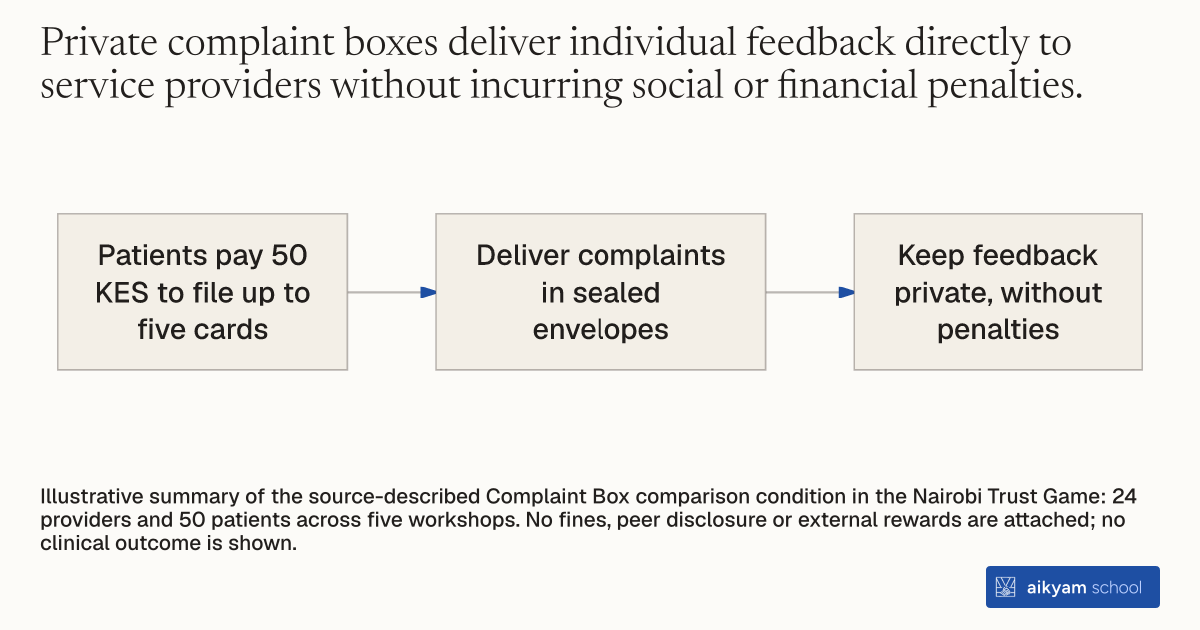
- Patients pay 50 KES to file up to five cards
- Deliver complaints in sealed envelopes
- Keep feedback private, without penalties
Illustrative summary of the source-described Complaint Box comparison condition in the Nairobi Trust Game: 24 providers and 50 patients across five workshops. No fines, peer disclosure or external rewards are attached; no clinical outcome is shown.
See source →How
When to use
Public health facilities in developing countries often rely on standard complaint boxes as a status quo feedback channel. This mechanism gathers patient feedback privately without imposing monetary fines or public disclosure on health providers. It serves as a benchmark for evaluating whether passive reporting alone can improve provider care.
Collect patient complaints privately and deliver them directly to individual health workers without external consequences or public disclosure.
- Provide exiting clinic patients with standard grievance evaluation forms following service encounters.
- Require patients to pay a 50 KES fee to file up to five disapproval cards detailing their dissatisfaction.
- Deliver received disapproval cards privately in sealed envelopes directly to the assigned health provider.
- Ensure no administrative fines, peer disclosures, or external rewards are attached to the received complaint cards.
Why it works
Because complaints remain private and lack tangible consequences, providers face no extrinsic or reputational pressure to increase their effort.
Example
In Nairobi, Kenya, researchers evaluated this baseline mechanism across 5 workshop sessions with 24 health providers and 50 patients from public and private facilities. When complaints were delivered privately with zero penalties, health providers returned an average ratio of 1.039 of transferred funds to patients, establishing the control benchmark for provider reciprocity.
About the study
Participants
24 health providers (18 public sector, 6 private sector) and 50 patients recruited from 93 health centers and dispensaries in Nairobi, Kenya.
Study Design
Lab-in-the-field experiment using strategy-elicited Trust Games establishing the Complaint Box control baseline, evaluated via OLS regressions with wild cluster bootstrap standard errors.
Results
In the Complaint Box control group, providers returned a baseline average returned-received ratio of 1.039 to patients, with 62.5% returning at least as much as sent, while 29.3% of patients filed complaints across low-return scenarios.