Try, learn and adjust
Check nightly step reporting
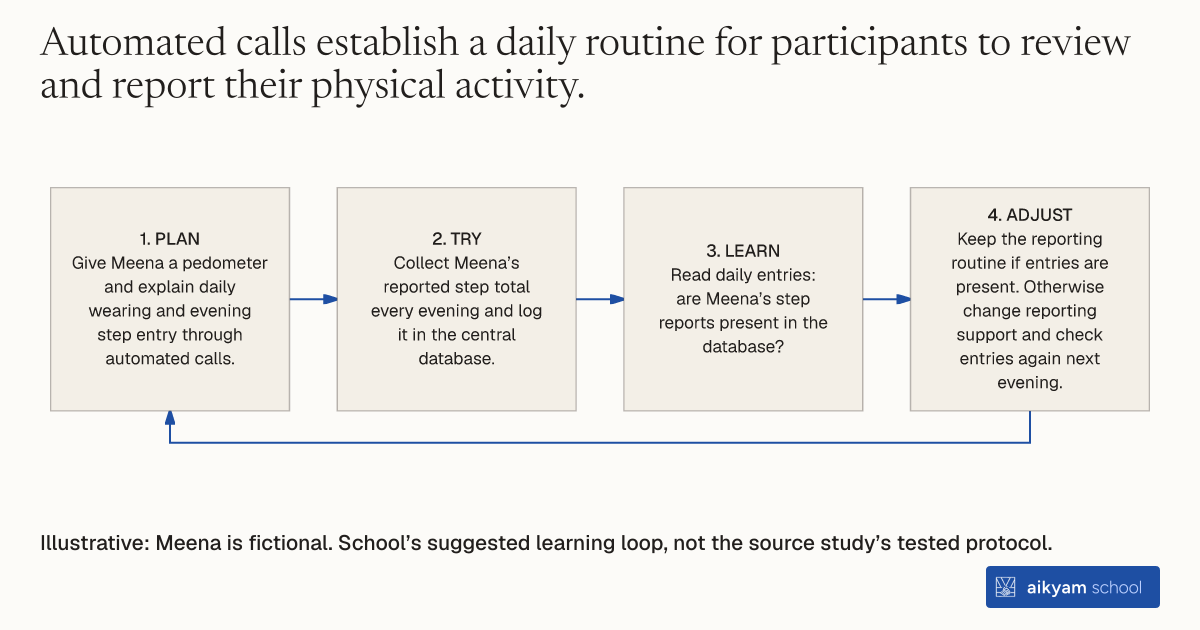
- Plan: Give Meena a pedometer and explain daily wearing and evening step entry through automated calls.
- Try: Collect Meena’s reported step total every evening and log it in the central database.
- Learn: Read daily entries: are Meena’s step reports present in the database?
- Adjust: Keep the reporting routine if entries are present. Otherwise change reporting support and check entries again next evening.
Illustrative: Meena is fictional. School’s suggested learning loop, not the source study’s tested protocol.
See source →School’s suggested, untested loop: observe daily reported totals and database entries; reports alone do not establish accuracy or health effects.
How
When to use
Health programs tracking daily behaviors in large populations often struggle with high operational costs and manual data collection errors. Automated calling systems provide a low-cost method to collect daily self-reported health data. This method helps health programs monitor step counts and physical activity among urban adults managing chronic diseases like diabetes.
Set up an automated phone system to collect self-reported daily step counts from program participants every evening.
- Provide participants with pedometers to track daily step totals.
- Instruct participants to wear pedometers throughout the day to record steps taken.
- Initiate or receive automated phone calls every evening to collect step counts.
- Prompt participants during the call to enter their daily pedometer step totals.
- Log the daily step data into a central database for tracking and incentive processing.
Why it works
Nightly reporting increases self-awareness of daily exercise and provides structured monitoring with minimal staff overhead.
Example
In Tamil Nadu, India, researchers used an automated calling system to track daily step counts for urban diabetics and pre-diabetics over a twelve-week period. Participants reported their pedometer steps every evening, allowing researchers to evaluate physical activity levels across incentive and monitoring groups.
About the study
Participants
3,192 urban diabetics and pre-diabetics in Tamil Nadu, India; average age almost 50 years; 58 percent male.
Study Design
Randomized controlled trial with daily step reporting via automated phone calls over 12 weeks.
Results
Participants in the monitoring-only group who reported steps daily met the 10,000-step target on 29 percent of days, averaging approximately 6,770 steps per day.