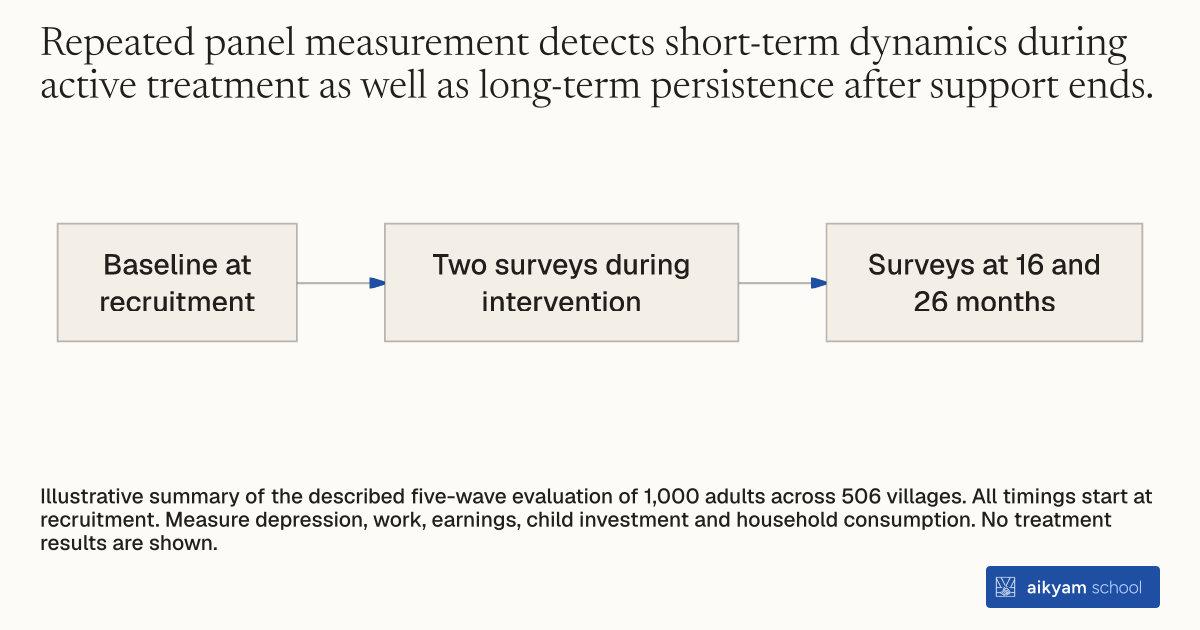
Research steps
Track health and livelihoods over 26 months
- Baseline at recruitment
- Two surveys during intervention
- Surveys at 16 and 26 months
Illustrative summary of the described five-wave evaluation of 1,000 adults across 506 villages. All timings start at recruitment. Measure depression, work, earnings, child investment and household consumption. No treatment results are shown.
See source →How
When to use
Evaluating the long-term impacts of healthcare and economic interventions requires tracking participant outcomes beyond the active intervention period. Single-point surveys fail to capture whether health benefits persist or fade over time. Administering a multi-wave panel survey over 26 months tracks participant trajectories, program decay, and long-term economic outcomes across target cohorts.
Administer five structured survey rounds across a 26-month evaluation timeline to evaluate mental health and socioeconomic outcomes over time.
- Survey enumerators conduct a baseline survey at initial participant recruitment.
- Field staff execute two follow-up survey rounds during the active intervention period.
- Research teams collect a post-program survey wave 16 months after initial recruitment.
- Surveyors perform a final survey round 26 months post-recruitment to measure long-term persistence.
- Analysts evaluate changes in depression severity, work hours, earnings, child human capital investment, and household consumption across all five survey rounds.
Why it works
Tracking households across five waves isolates immediate intervention side effects from sustained economic and psychological benefits.
Example
Researchers administered five survey rounds between 2016 and 2018 to 1,000 adults with mild or moderate depression across 506 villages near Bangalore, India, measuring depression severity, work time, earnings, child human capital investment, and household consumption up to 26 months post-recruitment.
About the study
Participants
1,000 adults with mild or moderate depression symptoms (86 percent women) across 506 villages near Bangalore, India.
Study Design
Four-arm randomized evaluation tracking participants across five survey waves from baseline through 26 months post-recruitment between 2016 and 2018.
Results
The multi-wave evaluation revealed that psychiatric care reduced depression by 0.14 standard deviations during treatment but work time fell by 5.4 hours per week, while bundled care sustained a 0.26 standard deviation reduction post-program.