Research steps
Build the baseline wealth index
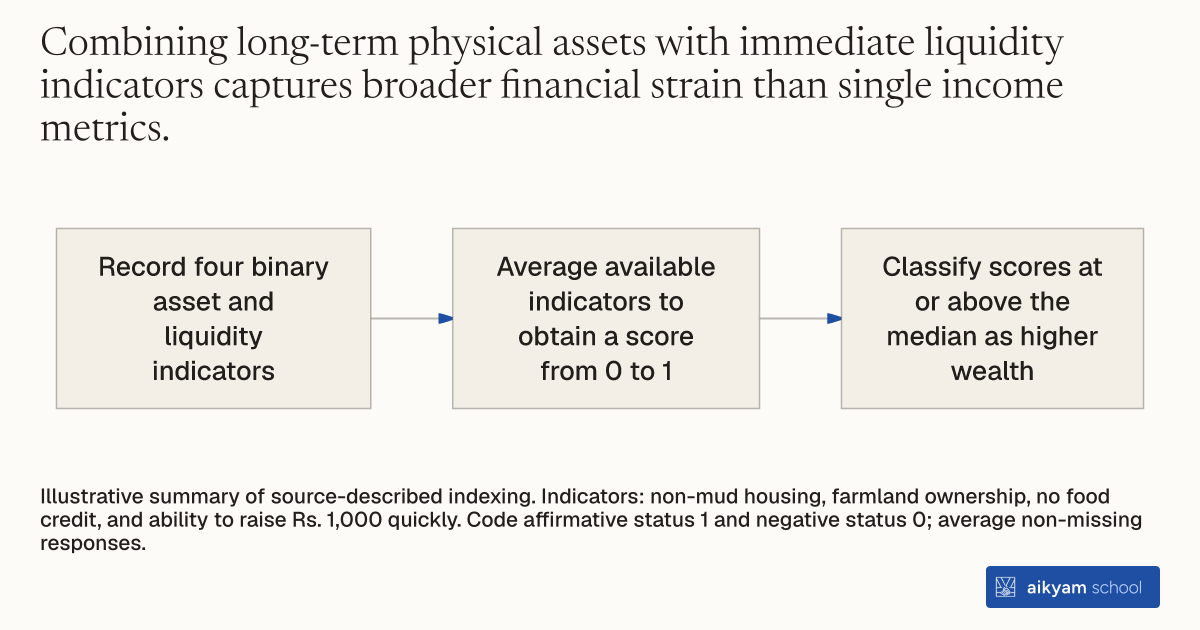
- Record four binary asset and liquidity indicators
- Average available indicators to obtain a score from 0 to 1
- Classify scores at or above the median as higher wealth
Illustrative summary of source-described indexing. Indicators: non-mud housing, farmland ownership, no food credit, and ability to raise Rs. 1,000 quickly. Code affirmative status 1 and negative status 0; average non-missing responses.
See source →How
When to use
Measure baseline financial vulnerability and liquid assets among low-income casual workers. It addresses the problem that single measures like income or land ownership fail to capture household liquidity and housing quality in informal labor markets. It serves development economists and project planners evaluating heterogeneous treatment impacts across asset levels.
Calculate a composite baseline wealth index by combining housing quality, land assets, and short-term liquidity proxies.
- Administer a baseline survey during onboarding to gather demographic, asset, and liquidity data.
- Record four binary indicators for each worker: durable housing construction (living in a non-mud house), farmland ownership, absence of food credit from grocers or neighbors, and emergency cash access (ability to raise Rs. 1,000 quickly).
- Code each binary indicator as 1 for present or affirmative status and 0 for absent or negative status.
- Calculate the unweighted arithmetic mean of the available binary indicators to generate a continuous wealth score between 0 and 1.
- Average the remaining non-missing indicators if any single response is absent due to non-response.
- Create a binary indicator classifying workers as higher-wealth if their continuous index score equals or exceeds the sample median score.
Why it works
Simple binary averaging avoids subjective weighting while accommodating missing data without dropping participants.
Example
In rural Odisha, India, research staff collected four binary wealth proxies from 407 casual manufacturing workers, deriving a mean baseline wealth index score of 0.406. Interacting treatment status with the wealth index revealed that productivity gains from mid-contract cash disbursements were concentrated among below-median wealth workers (+0.204 standard deviations, p=0.003).
About the study
Participants
407 male casual manufacturing workers in rural Odisha, India (17,381 worker-hour production observations).
Study Design
Composite baseline indexing using four binary asset and liquidity indicators (housing durability, farmland, food credit avoidance, emergency cash access) to analyze heterogeneous treatment impacts across continuous and median-split binary wealth tiers.
Results
Below-median wealth workers increased output by 0.204 SDs (13.0%, p=0.003) following an interim payment, whereas no significant output change was detected among above-median wealth workers (p=0.819).