Research health measurement
Record prenatal haemoglobin for baseline assessment
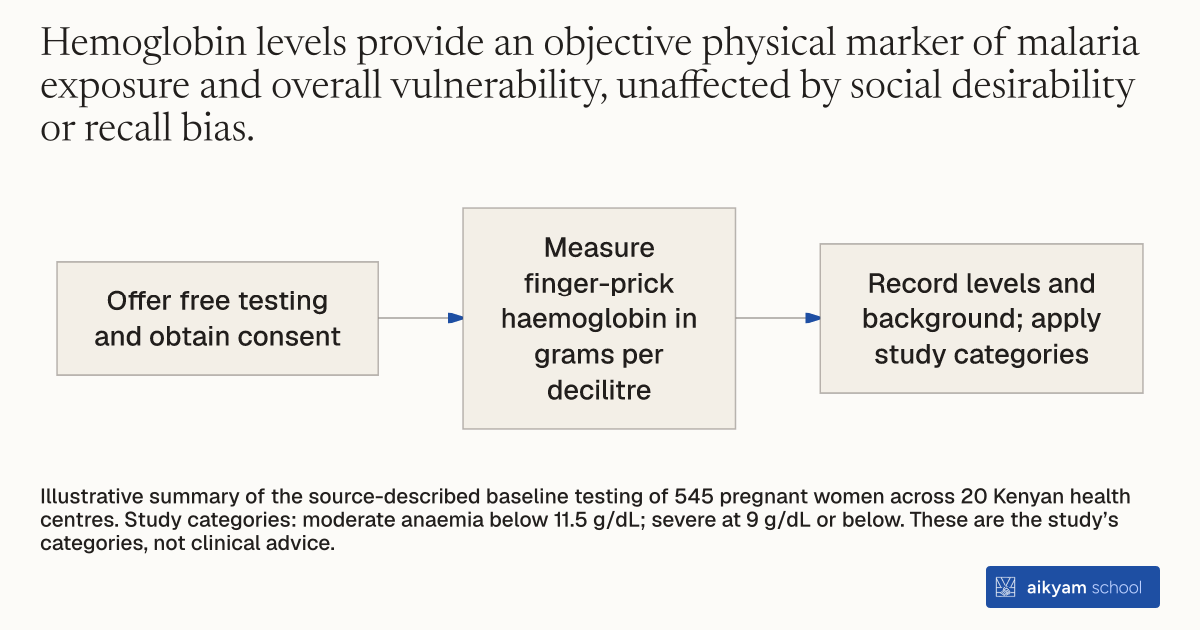
- Offer free testing and obtain consent
- Measure finger-prick haemoglobin in grams per decilitre
- Record levels and background; apply study categories
Illustrative summary of the source-described baseline testing of 545 pregnant women across 20 Kenyan health centres. Study categories: moderate anaemia below 11.5 g/dL; severe at 9 g/dL or below. These are the study’s categories, not clinical advice.
See source →How
When to use
Pregnant women in malaria-endemic regions face elevated risks of maternal anemia due to repeated parasitic infections. Program evaluators and health workers require objective baseline health indicators to assess population vulnerability and diagnose health needs. Conducting rapid blood tests during routine clinic visits identifies sicker patients without relying on self-reported symptoms.
Measure blood hemoglobin levels among expectant mothers during routine prenatal care visits to evaluate baseline anemia and health vulnerability.
- Clinic health workers or research enumerators offer a complimentary hemoglobin blood test to pregnant women attending prenatal appointments.
- Staff collect a small finger-prick blood sample from each consenting patient during the clinic check-up.
- Enumerators analyze the blood sample using a portable diagnostic machine to determine exact hemoglobin concentration in grams per deciliter.
- Surveyors record the hemoglobin level alongside patient background details in baseline survey registers.
- Program analysts categorize clients with hemoglobin below 11.5 g/dL as moderately anemic and 9 g/dL or lower as severely anemic.
Why it works
Measuring anemia directly allows researchers to evaluate whether program mechanisms like cost-sharing effectively target sicker patients.
Example
Research enumerators offered free hemoglobin tests to pregnant women visiting 20 public health centers in western Kenya. Testing revealed a 69 percent baseline anemia rate among control clients, showing that women paying positive net prices were no sicker than average clients.
About the study
Participants
545 pregnant women surveyed and tested for hemoglobin across prenatal clinics in Busia, Bungoma, Butere, and Mumias districts in western Kenya.
Study Design
Baseline survey with finger-prick hemoglobin blood testing administered on random survey days across 20 randomized health centers.
Results
Baseline hemoglobin averaged 10.44 g/dL in control clinics with 69 percent moderate anemia (Hb < 11.5 g/dL) and 16 percent severe anemia (Hb ≤ 9 g/dL); free net distribution reduced moderate anemia among clients by 18 percentage points due to return visit incentive effects.