Research procedure
Test malaria status after drug purchase
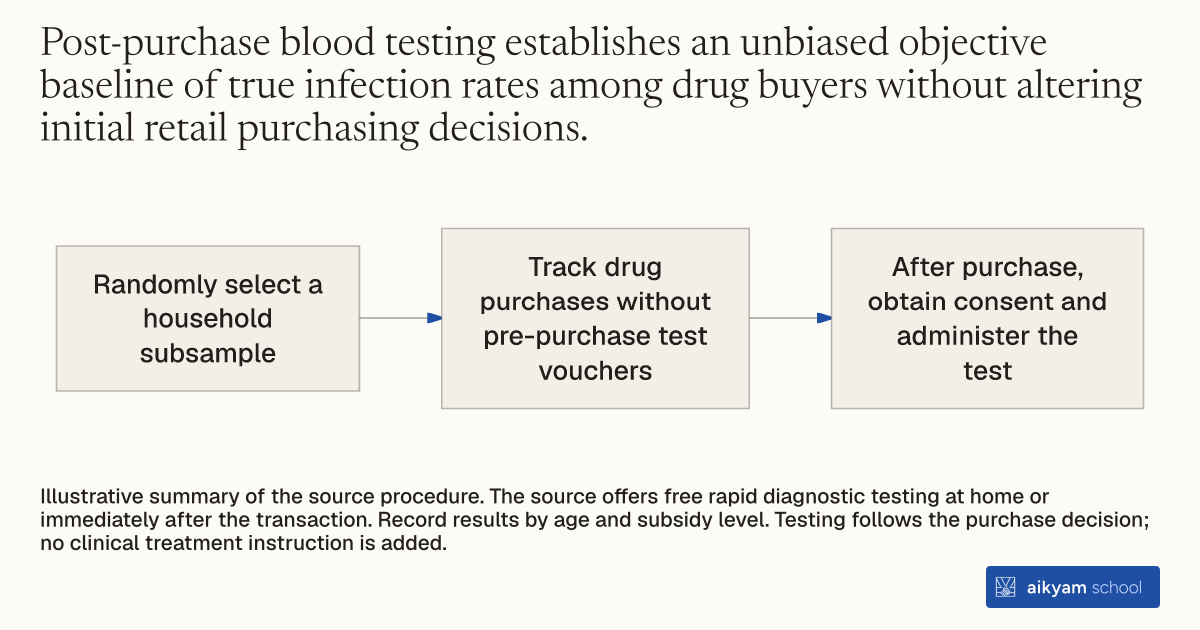
- Randomly select a household subsample
- Track drug purchases without pre-purchase test vouchers
- After purchase, obtain consent and administer the test
Illustrative summary of the source procedure. The source offers free rapid diagnostic testing at home or immediately after the transaction. Record results by age and subsidy level. Testing follows the purchase decision; no clinical treatment instruction is added.
See source →How
When to use
Evaluating retail drug subsidy programs requires determining whether people buying over-the-counter antimalarials actually have malaria parasites. Self-diagnosis leads to widespread overtreatment, but shopkeepers and patients often do not perform pre-purchase diagnostic blood tests. Administering post-purchase rapid diagnostic tests to a random sample of buyer households identifies true infection rates and evaluates how well subsidies target infected individuals.
Administer rapid diagnostic blood tests to a randomly selected sub-sample of buyer households following over-the-counter antimalarial drug purchases.
- Select a random sub-sample of households enrolled in a retail drug subsidy program to receive post-purchase diagnostic testing.
- Station trained field researchers at participating local drug shops to log customer transactions and track medication purchases.
- Identify customers who purchase artemisinin combination therapies without redeeming pre-purchase testing vouchers.
- Visit selected households immediately after drug purchase or offer immediate testing at the conclusion of the retail transaction.
- Obtain consent and administer a finger-prick rapid diagnostic blood test to the patient taking the medication.
- Record the test result to calculate true malaria positivity rates across patient age groups and subsidy levels.
Why it works
Comparing test results across demographic groups reveals where subsidies successfully treat genuine disease versus where they fund unnecessary medication.
Example
In western Kenya between May and December 2009, researchers conducted post-purchase rapid diagnostic testing on a random sub-sample of households buying subsidized antimalarials at four rural drug shops. The testing revealed that 82 percent of children under 18 taking subsidized artemisinin therapies actually had malaria parasites, compared to only 25 percent of adults over 18.
About the study
Participants
2,789 households living near four rural drug shops in western Kenya, where 38 percent of household heads were illiterate.
Study Design
Randomized controlled trial conducted from May to December 2009. Researchers randomly selected a sub-sample of enrolled households buying artemisinin combination therapies without a pre-purchase test voucher, administered post-purchase rapid diagnostic blood tests, and analyzed parasite positivity rates across age brackets and price subsidy tiers (92%, 88%, and 80%).
Results
Post-purchase testing demonstrated that 82 percent of children under 18 who received subsidized ACTs tested positive for malaria, whereas only 25 percent of adults tested positive. Reducing the drug subsidy level from 92 percent to 80 percent increased the proportion of ACT takers testing positive for malaria from 56 percent to 75 percent.