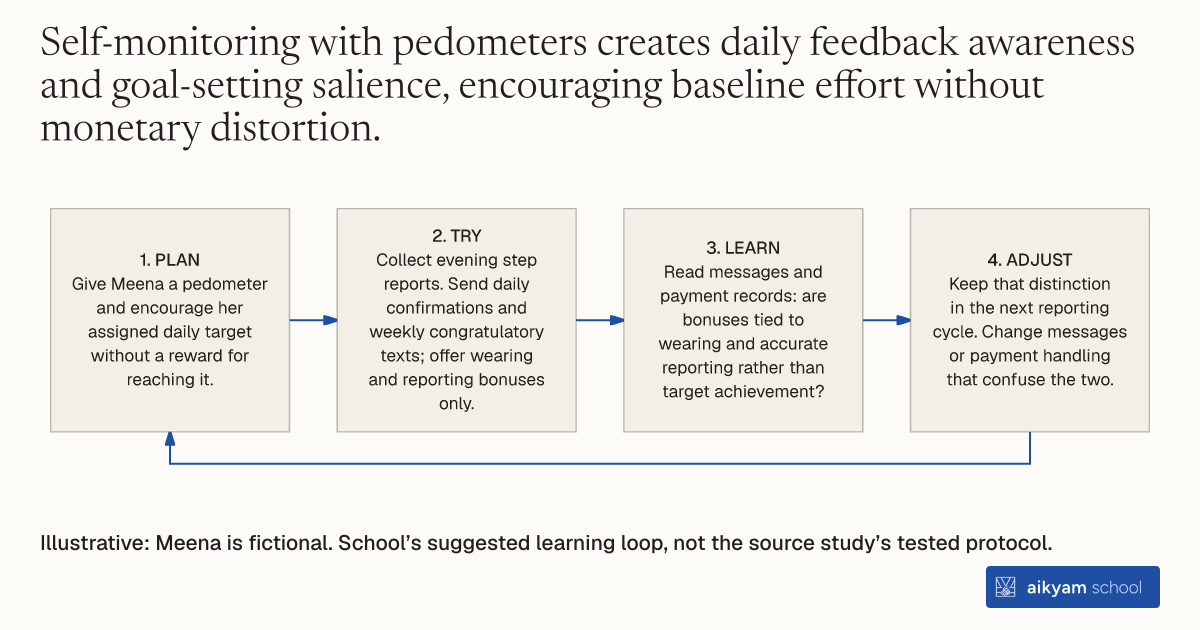
Try, learn and adjust
Check monitoring without step-target payments
- Plan: Give Meena a pedometer and encourage her assigned daily target without a reward for reaching it.
- Try: Collect evening step reports. Send daily confirmations and weekly congratulatory texts; offer wearing and reporting bonuses only.
- Learn: Read messages and payment records: are bonuses tied to wearing and accurate reporting rather than target achievement?
- Adjust: Keep that distinction in the next reporting cycle. Change messages or payment handling that confuse the two.
Illustrative: Meena is fictional. School’s suggested learning loop, not the source study’s tested protocol.
See source →School’s suggested, untested loop. Observe step reports, congratulatory messages and compliance bonuses; the monitoring group received no step-target payments.
How
When to use
Health promotion programs need to evaluate whether financial incentive schemes genuinely increase physical activity beyond the effect of simple tracking and goal-setting encouragement. Providing pedometers without monetary rewards establishes a clean behavioral baseline for adults managing chronic illnesses. This enables program administrators to isolate the specific impact of financial payments from the psychological effects of self-monitoring.
Track physical activity using pedometers and non-monetary daily encouragement without providing financial rewards for hitting step targets.
- Provide participants with digital pedometers during household visits and instruct them on daily wear.
- Verbally encourage participants to reach an assigned daily step target of 10,000, 12,000, or 14,000 steps.
- Require participants to report daily step counts every evening using an automated phone system.
- Send daily confirmation and weekly congratulatory text messages upon target achievement without mentioning monetary payments.
- Offer flat completion bonuses solely for wearing pedometers and reporting steps accurately.
Why it works
Standardizing non-financial messaging isolates the pure treatment effect of financial incentives when evaluating policy mechanisms.
Example
In Coimbatore, Tamil Nadu, India, 207 adults with diabetes or hypertension received pedometers, daily step targets, and congratulatory text messages without step target incentives, maintaining an average of 7,192 daily steps over a four-week evaluation period.
About the study
Participants
207 participants in the Monitoring group out of 6,882 enrolled adults aged 30 to 65 (mean age 49, 37% female, 31% diabetic, 32% hypertensive) in urban Coimbatore, Tamil Nadu, India.
Study Design
Control arm within an RCT receiving pedometers, verbal target encouragement, interactive voice step reporting, non-monetary congratulatory texts, and pedometer-wearing compliance bonuses (100 INR for 80% compliance, 200 INR total for 100%) over 4 weeks.
Results
Participants in the Monitoring group averaged 7,192 steps per day during the contract period with 0 INR daily incentive payouts, establishing the baseline against which Fixed incentives increased walking by 528–704 daily steps and Choice increased walking by 948 daily steps.