Try, learn and adjust
Check established routines during a manager handover
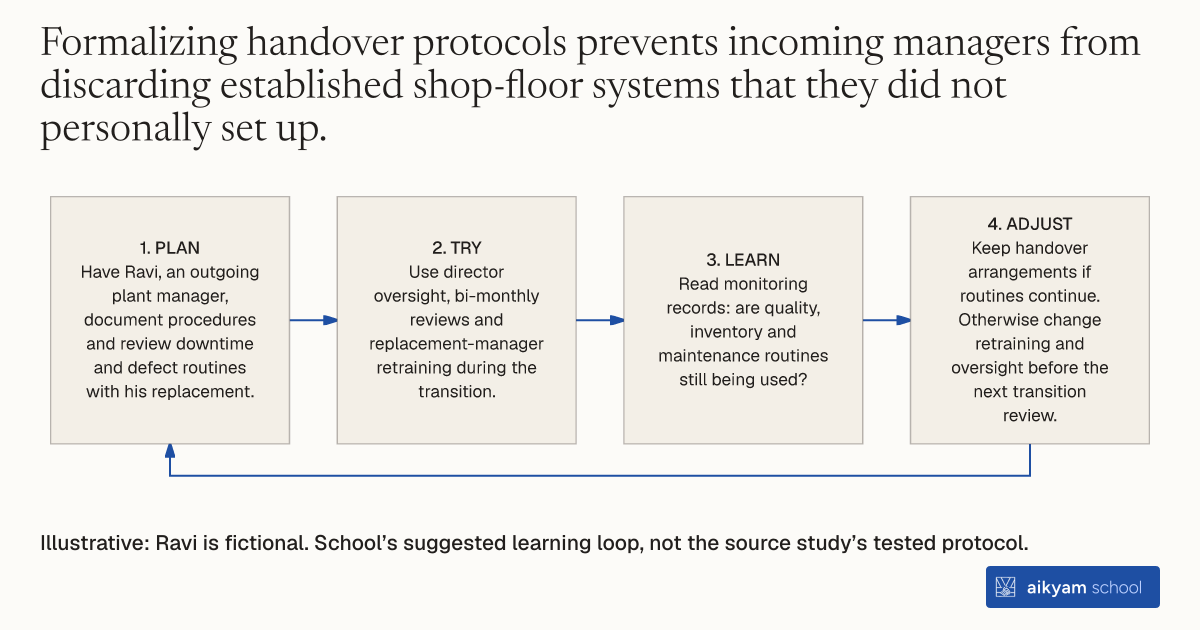
- Plan: Have Ravi, an outgoing plant manager, document procedures and review downtime and defect routines with his replacement.
- Try: Use director oversight, bi-monthly reviews and replacement-manager retraining during the transition.
- Learn: Read monitoring records: are quality, inventory and maintenance routines still being used?
- Adjust: Keep handover arrangements if routines continue. Otherwise change retraining and oversight before the next transition review.
Illustrative: Ravi is fictional. School’s suggested learning loop, not the source study’s tested protocol.
See source →School’s suggested, untested loop: observe continued routines during handover; this suggested loop is not evidence that the study tested a handover intervention.
How
When to use
Manufacturing facilities frequently experience operational decay when key plant managers leave and incoming leadership lacks familiarity with established shop-floor routines. This method codifies operational practices into formal institutional protocols and mandates structured handover procedures during plant manager successions. It helps factory owners and executive leadership preserve quality systems and prevent management practice drops when personnel changes occur.
Establish structured plant manager handover protocols and institutionalized operational documentation to maintain management practice retention during leadership transitions.
- Codify all plant-level standard operating procedures, daily monitoring routines, and quality inspection workflows into written operational manuals.
- Require outgoing plant managers to conduct structured onboarding sessions with incoming managers to review daily downtime tracking sheets and defect analysis routines.
- Assign executive directors to oversee plant manager transitions and audit shop-floor monitoring systems during leadership handovers.
- Schedule bi-monthly management reviews during manager successions to verify that newly appointed plant managers maintain established quality control and inventory practices.
- Provide continuous retraining to replacement plant managers on standardized machine maintenance and floor organization systems.
Why it works
Executive oversight during leadership transitions ensures new managers remain accountable for maintaining daily monitoring and quality routines.
Example
In experimental textile plants near Mumbai, India, between 2011 and 2017, the departure of a plant manager caused the dropping of 9.9% of target management practices, accounting for over half of all practice drops in treated experimental plants.
About the study
Participants
28 manufacturing plants across 17 family-owned cotton weaving firms near Mumbai, India, averaging 270 employees, $8.5 million in assets, and $7.5 million in annual sales.
Study Design
Randomized Controlled Trial (RCT) tracking 38 management practices across 1,042 practice-by-plant cells between 2011 and 2017.
Results
Managerial turnover was the single largest cause of practice decay, accounting for 9.9% of dropped practices out of 16.7% total practice drops in treatment experimental plants between 2011 and 2017.