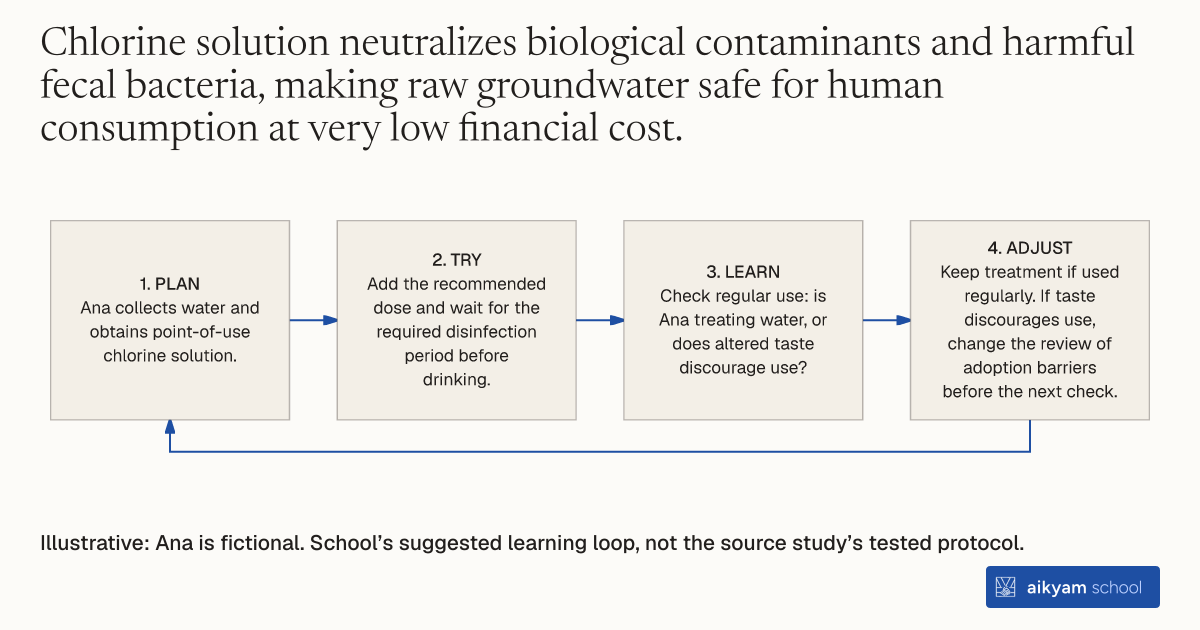
Try, learn and adjust
Check regular household water treatment
- Plan: Ana collects water and obtains point-of-use chlorine solution.
- Try: Add the recommended dose and wait for the required disinfection period before drinking.
- Learn: Check regular use: is Ana treating water, or does altered taste discourage use?
- Adjust: Keep treatment if used regularly. If taste discourages use, change the review of adoption barriers before the next check.
Illustrative: Ana is fictional. School’s suggested learning loop, not the source study’s tested protocol.
See source →School’s suggested learning loop: observe dosing, waiting and regular use; no dose or waiting time is specified here.
How
When to use
Rural households in low-income regions rely on contaminated surface or groundwater containing harmful bacteria and pathogens. Centralized piped water networks are prohibitively expensive to build in remote communities. Point-of-use chlorine water treatment offers a low-cost, decentralized method for families to disinfect drinking water at home.
Treat contaminated drinking water directly at home using point-of-use chlorine solutions to eliminate biological pathogens.
- Households collect untreated groundwater or surface water from local village sources.
- Users acquire point-of-use chlorine solution or disinfectant drops for household water treatment.
- Household members add the recommended dose of chlorine drops directly to collected water containers.
- Users allow the chlorine solution to sit in the water container for the required disinfection period.
- Families consume the treated drinking water directly at home.
Example
Evaluations tested point-of-use chlorine treatment across rural communities in low-income settings, showing that while affordable and effective at reducing health risks, few households adopted regular use even when offered free chlorine solution due to altered taste.
About the study
Participants
Households in rural low-income settings facing contaminated water sources where 26 percent lack clean water access.
Study Design
Randomized evaluations testing household adoption rates and health risk reductions from point-of-use chlorine treatment compared to alternative clean water delivery models.
Results
Chlorine treatments proved affordable and biologically effective at reducing health risks, but achieved low regular adoption due to poorer tasting water compared to home-delivered purified water.