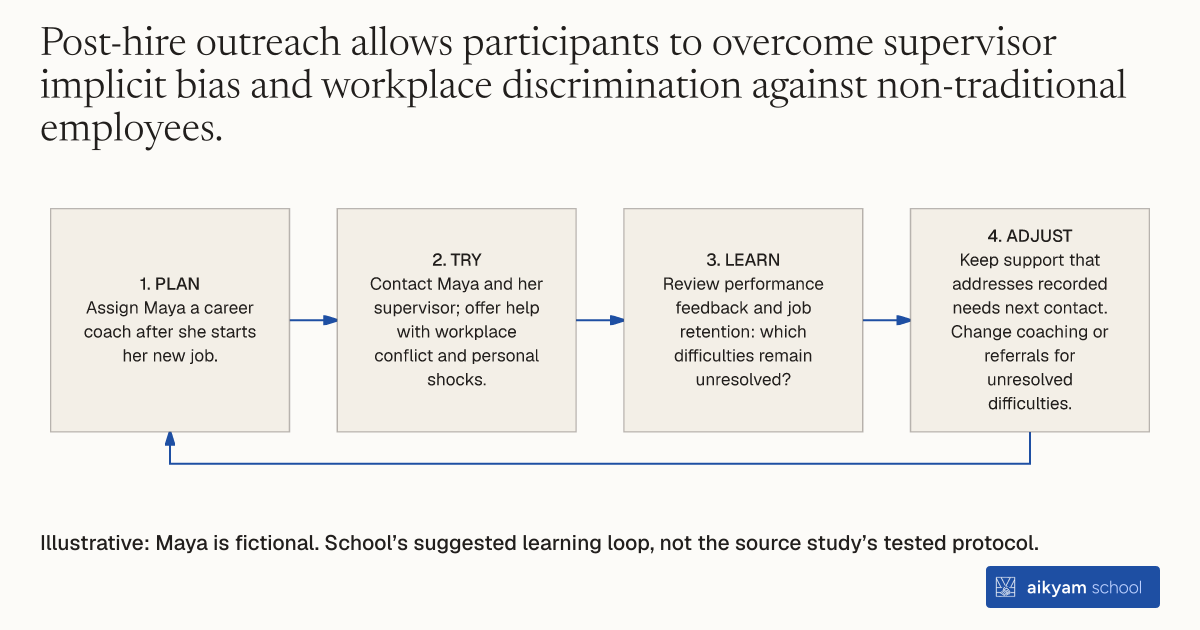
Try, learn and adjust
Check support after a graduate starts work
- Plan: Assign Maya a career coach after she starts her new job.
- Try: Contact Maya and her supervisor; offer help with workplace conflict and personal shocks.
- Learn: Review performance feedback and job retention: which difficulties remain unresolved?
- Adjust: Keep support that addresses recorded needs next contact. Change coaching or referrals for unresolved difficulties.
Illustrative: Maya is fictional. School’s suggested learning loop, not the source study’s tested protocol.
See source →School’s suggested, untested learning loop. Observe worker and employer feedback, workplace difficulties and retention; this loop does not establish programme impact.
How
When to use
Newly hired non-traditional workers and employees of color frequently encounter workplace friction, supervisor bias, or unexpected life shocks after starting new jobs. Without post-employment guidance, early workplace misunderstandings can lead to premature job loss. Program staff solve this problem for low-income workers by offering ongoing coaching and retention support after hiring.
Provide ongoing communication, coaching, and support to placed participants and employers after job entry.
- Assign career coaches or case managers to contact newly hired workers regularly during their initial months of employment.
- Communicate with employers and supervisors to monitor worker performance and identify early workplace friction.
- Advise workers on resolving workplace misunderstandings, navigating supervisor expectations, and overcoming implicit bias.
- Provide emergency support or referrals when personal life shocks threaten job retention.
- Offer career advancement coaching to help participants pursue salary increases and promotions over time.
Why it works
Ongoing staff contact helps workers resolve personal life shocks and job conflicts before they cause employment loss.
Example
Per Scholas and Jewish Vocational Service in Boston provided post-employment retention services and career mentoring to placed graduates in information technology and healthcare jobs.
About the study
Participants
Human low-income adult job seekers across mature sectoral programs evaluated in the Sectoral Employment Impact Study.
Study Design
Randomized Controlled Trial (RCT) evaluated by Maguire et al. (2010) measuring employment persistence, benefit access, and earnings over two years.
Results
Post-hire retention services helped participants work an average of 1.3 months longer (a 9.6 percent increase, p < 0.01) and achieve a 10 percentage point gain in jobs offering health benefits (57 percent versus 47 percent, p < 0.01).