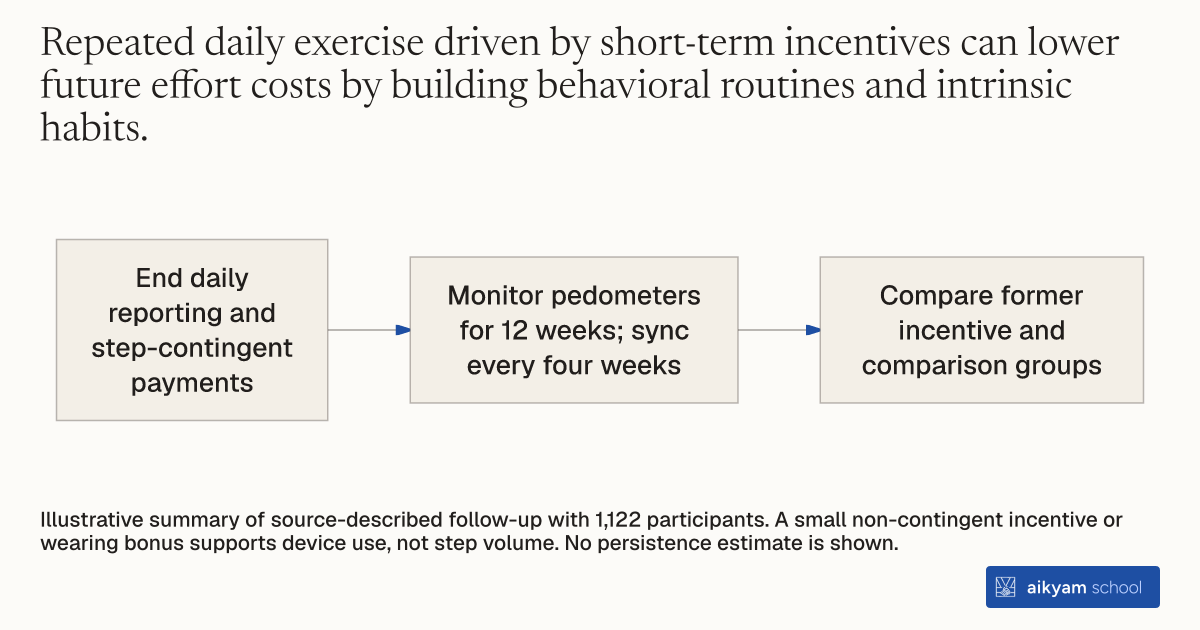
Research steps
Track walking after incentives end
- End daily reporting and step-contingent payments
- Monitor pedometers for 12 weeks; sync every four weeks
- Compare former incentive and comparison groups
Illustrative summary of source-described follow-up with 1,122 participants. A small non-contingent incentive or wearing bonus supports device use, not step volume. No persistence estimate is shown.
See source →How
When to use
Health behavior change programs need to assess whether physical activity habits persist after financial incentive payments discontinue. Short-term incentives may produce temporary compliance that fades immediately once rewards end. This method serves public health projects evaluating habit formation and long-term behavioral maintenance in adult populations managing chronic conditions.
Track physical activity using un-incentivized wearable monitors following the conclusion of an incentive program to evaluate habit persistence.
- Conclude daily step reporting and financial incentive payments at the end of the intervention period.
- Provide participants with tracking pedometers to wear continuously for a 12-week post-intervention monitoring period.
- Offer a small non-contingent incentive or modest wearing bonus to maintain high pedometer wearing adherence without incentivizing step volume.
- Instruct participants to maintain their normal daily routines without submitting daily step reports.
- Send field workers every four weeks to sync physical pedometer memory with the central database.
- Compare post-intervention step counts between former incentive recipients and comparison group participants to quantify habit persistence.
Why it works
Un-incentivized tracking measures whether physical activity persists after external financial rewards are removed.
Example
Surveyors monitored pedometer step counts for 1,122 participants across Coimbatore, India, for 12 weeks after a 3-month exercise incentive program ended. Former incentive recipients continued walking 537 additional steps per day compared to the control group, demonstrating that 60 percent of the intervention treatment effect on step volume persisted.
About the study
Participants
1,122 participants evaluated during the 12-week post-intervention period in Coimbatore, India, with an average age of 50 years, 42 percent female, 67 percent diagnosed diabetic, and an average monthly household income of 16,000 INR.
Study Design
A post-intervention follow-up study tracking pedometer step data for 12 weeks following the end of a 12-week exercise incentive trial, with field workers visiting every 4 weeks to sync device memory without offering step-contingent payments.
Results
Former incentive recipients maintained a statistically significant step-target compliance increase of 7.1 percentage points and walked 537 additional steps per day relative to comparison groups, preserving 60 percent of the intervention treatment effect.