Research groups
Compare post-election exposure
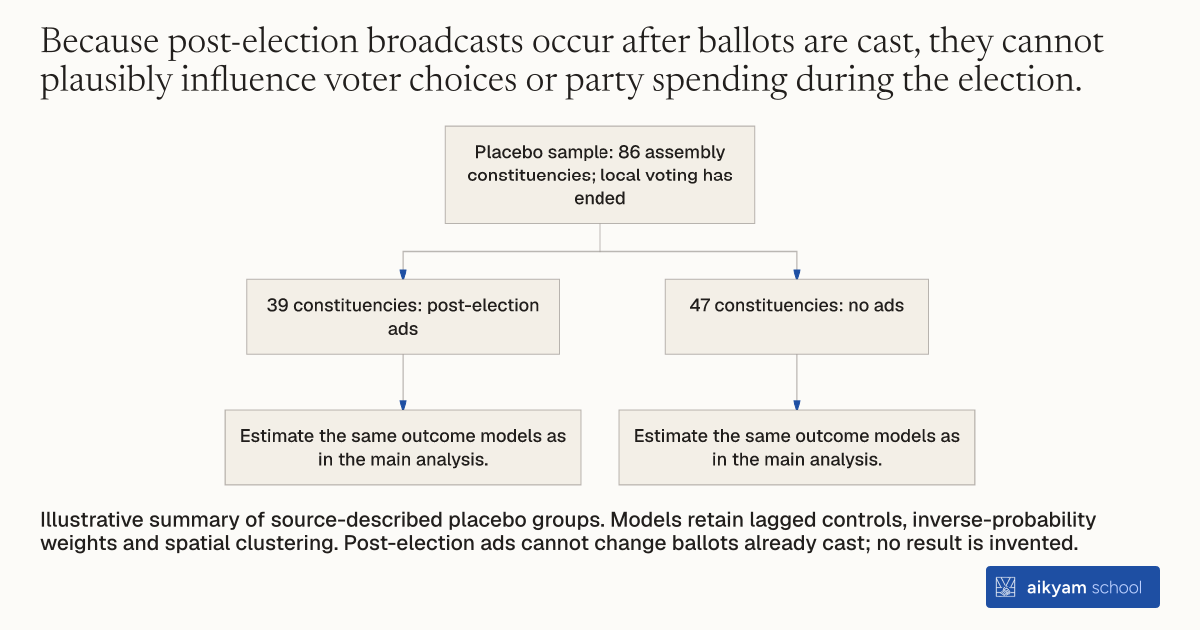
Placebo sample: 86 assembly constituencies; local voting has ended
- 39 constituencies: post-election ads
- Estimate the same outcome models as in the main analysis.
- 47 constituencies: no ads
- Estimate the same outcome models as in the main analysis.
Illustrative summary of source-described placebo groups. Models retain lagged controls, inverse-probability weights and spatial clustering. Post-election ads cannot change ballots already cast; no result is invented.
See source →How
When to use
Evaluators measuring mass media campaigns need to verify that observed electoral shifts stem from persuasive communication rather than spurious baseline trends or unobserved geographic noise. Broadcast coverage areas sometimes deliver ads to sub-regions only after local polling has ended. Researchers can evaluate these post-election broadcast areas as a placebo test to rule out unobserved confounding factors.
Run placebo regressions on administrative units exposed to media broadcasts only after polling has concluded to confirm the absence of spurious treatment effects.
- Identify geographic units whose staggered election dates cause them to receive radio station broadcasts exclusively after local voting ends.
- Separate these post-election broadcast units from the primary evaluation sample into a distinct placebo sample.
- Compare placebo units covered by stations randomly assigned to broadcast the campaign against placebo units covered by non-broadcasting stations.
- Estimate identical regression models on the placebo sample using post-election treatment indicators and pre-election outcome covariates.
- Verify that post-election media exposure produces statistically insignificant coefficients centered around zero across all specifications.
Why it works
Observing zero effect in the placebo sample confirms that estimated pre-election campaign effects reflect genuine persuasion rather than underlying geographic or station-level differences.
Example
Researchers tested 86 assembly constituencies in India that were eligible to receive radio ads only after local polling concluded during the 2014 general elections. Thirty-nine constituencies received post-election radio broadcasts while 47 received no ads, yielding small, statistically insignificant estimates centered around zero that validated the main campaign findings.
About the study
Participants
The placebo sample comprised 86 assembly constituencies belonging to 34 parliamentary constituencies across Indian states, with 39 treated constituencies receiving post-election ads and 47 control constituencies receiving no ads.
Study Design
Researchers estimated inverse-probability weighted least squares regressions on the placebo sample using the exact outcome variables, lagged controls, and multi-way spatial clustering by radio station footprint used in the primary experiment.
Results
Post-election radio broadcasts produced no statistically significant effect on vote-buying party vote shares (coefficients ranged across specifications with 9 positive and 11 negative estimates centered near zero) or voter turnout rates (treatment estimate of -0.59 percentage points, p-value 0.78).