Try, learn and adjust
Check prices printed on discount vouchers
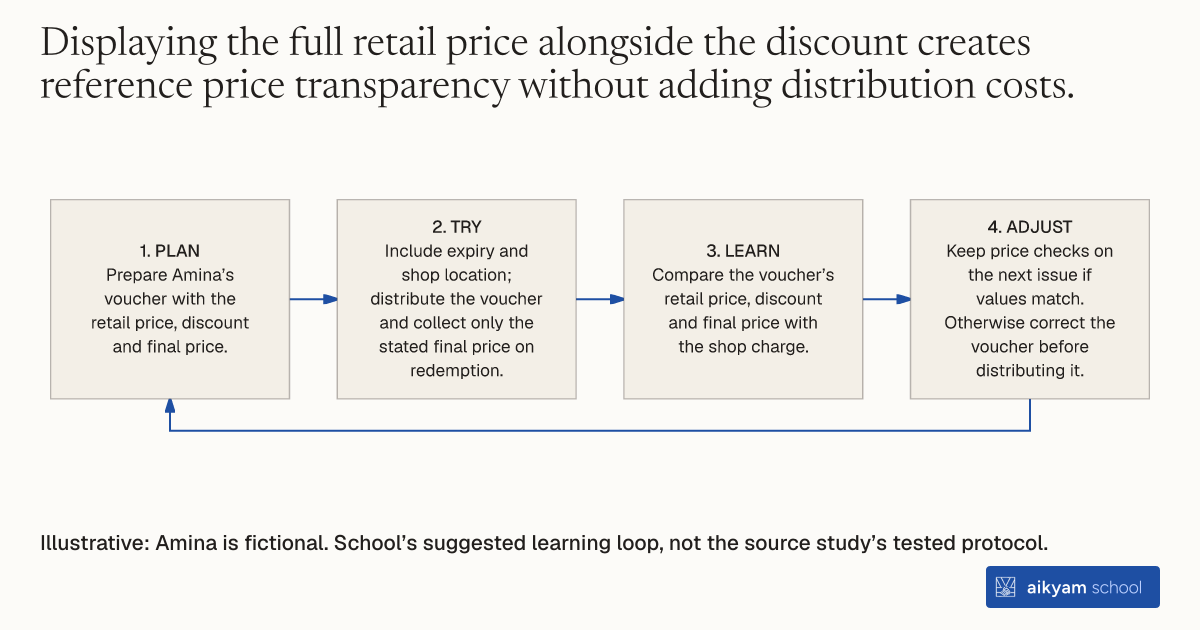
- Plan: Prepare Amina’s voucher with the retail price, discount and final price.
- Try: Include expiry and shop location; distribute the voucher and collect only the stated final price on redemption.
- Learn: Compare the voucher’s retail price, discount and final price with the shop charge.
- Adjust: Keep price checks on the next issue if values match. Otherwise correct the voucher before distributing it.
Illustrative: Amina is fictional. School’s suggested learning loop, not the source study’s tested protocol.
See source →School’s suggested, untested learning loop. Observe printed price fields and actual charges; these checks do not establish effects on later demand.
How
When to use
Programs offering heavily discounted or free health products need to prevent recipients from anchoring their long-term valuation to the low subsidized price. When consumers see a discounted price without context, they may assume the product is cheap or low quality. Printing the full market value directly on discount vouchers ensures consumers remain aware of the product's true commercial cost.
Print the non-subsidized recommended retail price and total discount amount on all promotional discount vouchers.
- Determine the non-subsidized commercial benchmark price for the health product prior to voucher distribution.
- Design discount vouchers to display four distinct fields: expiration date, designated retail outlet, final post-discount price, and official recommended retail price.
- Explicitly print the calculated monetary discount amount alongside the recommended retail price on each voucher stub.
- Distribute personalized vouchers directly to target households during field enrollment visits.
- Direct participating shopkeepers to process redemptions by collecting the final post-discount price stated on the voucher.
Why it works
Highlighting the monetary savings prevents consumers from assuming the subsidized price represents the product's true value, mitigating price anchoring.
Example
In Busia District, Kenya, researchers printed the full recommended retail price and exact monetary discount on vouchers issued to 1,120 households, maintaining price transparency across 17 randomized subsidy levels.
About the study
Participants
1,120 households across six rural enumeration areas in Busia District, Western Kenya.
Study Design
Randomized trial where vouchers explicitly displayed the recommended retail price and discount amount across 17 randomized price levels.
Results
Full price visibility combined with introductory subsidies led to a 49 percent increase in long-run willingness to pay at Ksh 150 (\$2.30), with structural estimation showing zero price anchoring (parameter estimate 0.0015).