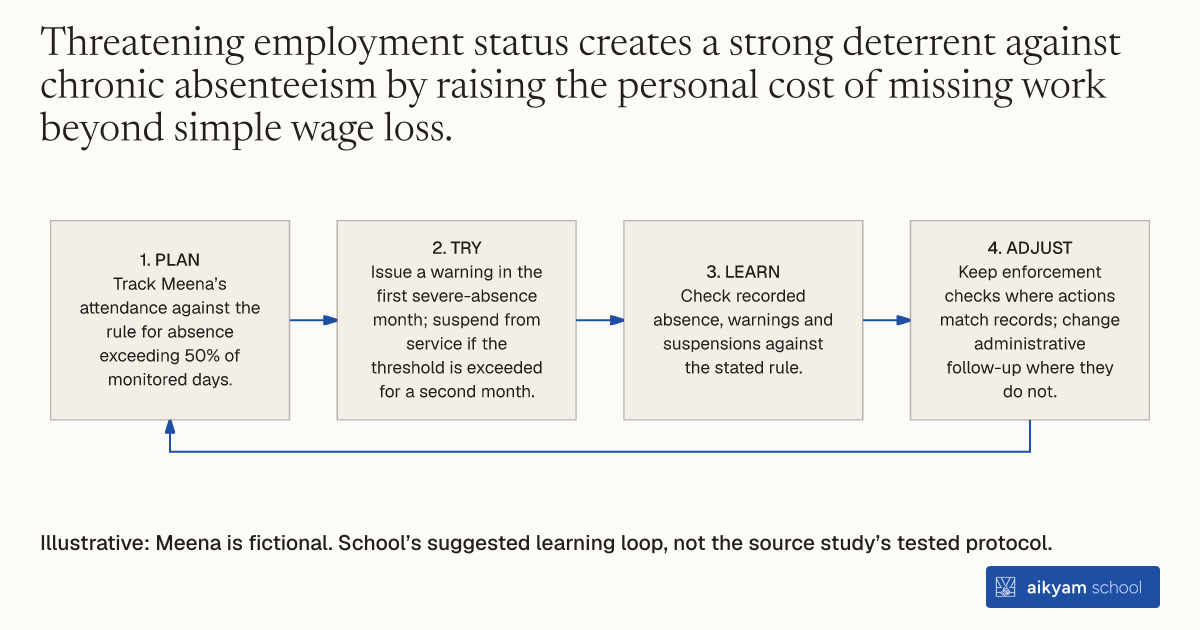
Try, learn and adjust
Check the stated absence rule is enforced
- Plan: Track Meena’s attendance against the rule for absence exceeding 50% of monitored days.
- Try: Issue a warning in the first severe-absence month; suspend from service if the threshold is exceeded for a second month.
- Learn: Check recorded absence, warnings and suspensions against the stated rule.
- Adjust: Keep enforcement checks where actions match records; change administrative follow-up where they do not.
Illustrative: Meena is fictional. School’s suggested learning loop, not the source study’s tested protocol.
See source →Observe monitored absence and official action. The combined programme’s early gains vanished after enforcement weakened. School suggests this learning loop; it was not tested by the source.
How
When to use
Public health facilities experience chronic staff absenteeism when financial penalties alone fail to ensure worker attendance. Healthcare workers may absorb partial pay deductions while continuing to miss work. Enforce official service suspension for staff who remain repeatedly absent beyond acceptable thresholds.
Suspend public health staff from government service when unexcused absences exceed established limits across consecutive monitoring periods.
- Establish a clear threshold defining severe absenteeism across monitored workdays.
- Track daily provider presence using tamper-proof time clocks and physical field audits.
- Identify workers who fail to meet the minimum attendance threshold in a given month.
- Issue a formal administrative warning upon the first month of severe non-attendance.
- Suspend any healthcare worker from government service who exceeds the absence threshold for a second month.
Example
In Udaipur District, India, the district health administration established a rule suspending Assistant Nurse Midwives who were absent for more than 50 percent of monitored days for two months. Combined with salary deductions, this penalty structure initially raised single-nurse clinic attendance on Mondays from 30 percent in comparison subcenters to 59 percent in monitored centers.
About the study
Participants
Assistant Nurse Midwives at public health subcenters serving 135 villages in Udaipur District, Rajasthan, India.
Study Design
Randomized controlled trial assessing attendance incentives and statutory suspension penalties enforced by district health authorities.
Results
The combined incentive and penalty system initially increased nurse attendance by 15 percentage points in two-nurse centers and 29 percentage points in single-nurse centers on Mondays, but gains vanished after 16 months as supervisors stopped enforcing suspensions.