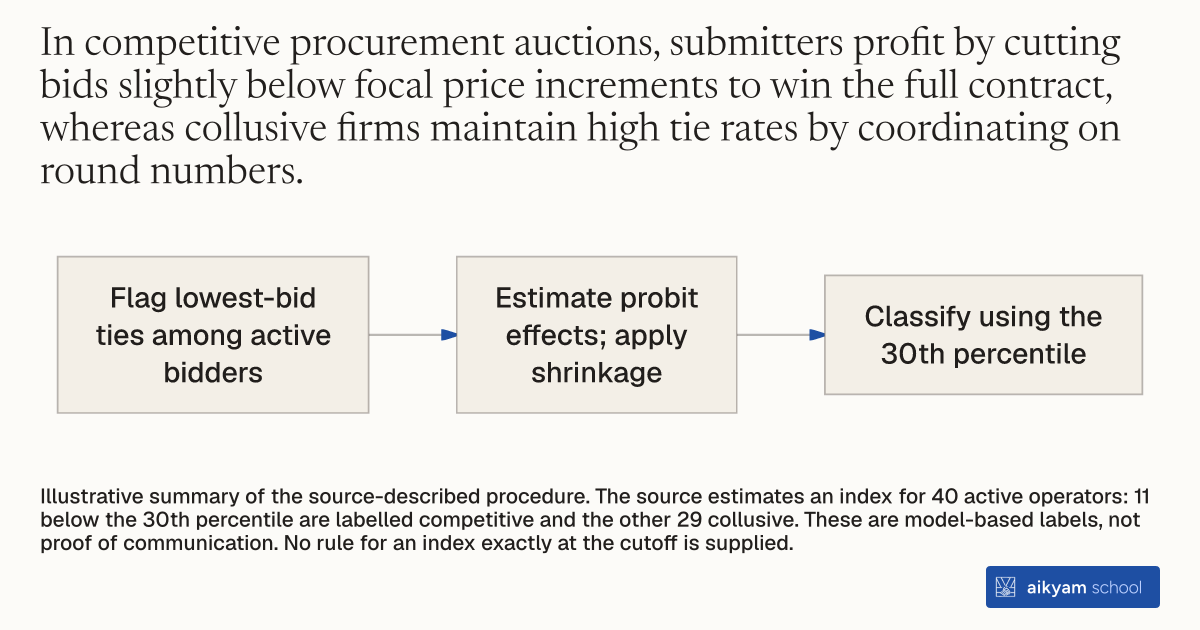
Research steps
Classify bidders using tie propensity
- Flag lowest-bid ties among active bidders
- Estimate probit effects; apply shrinkage
- Classify using the 30th percentile
Illustrative summary of the source-described procedure. The source estimates an index for 40 active operators: 11 below the 30th percentile are labelled competitive and the other 29 collusive. These are model-based labels, not proof of communication. No rule for an index exactly at the cutoff is supplied.
See source →How
When to use
Researchers or auction platform managers need to identify collusive bidding conduct among repeated auction participants without explicit evidence of cartel communication. The method addresses tacit collusion and focal price coordination in procurement markets where firms soft-pedal competition by submitting identical round bids. It is designed for regulatory economists and procurement managers seeking to filter competitive suppliers from non-competitive ones.
Screen and classify service providers based on their individual propensity to tie in sealed-bid auctions using a fixed-effects probit model with Bayesian shrinkage.
- Platform analysts log all bids submitted across repeated sealed-bid auctions and flag instances where two or more lowest bids tie at identical prices.
- Analysts restrict the analytical sample to active bidders who submit bids across at least 30 sealed-bid auctions to ensure adequate sample depth.
- Analysts estimate a probit model of the probability that a bid results in a tie, incorporating bidder-level fixed effects alongside auction and client location controls.
- Analysts apply a Bayesian shrinkage correction to the estimated fixed effects by projecting them onto observable bidder characteristics, such as fleet size and main garage location.
- Analysts convert the corrected bidder fixed effects into a standardized collusivity index that quantifies each provider's underlying propensity to tie.
- Platform managers classify bidders with an index below the 30th percentile as competitive types and bidders above as collusive types.
Why it works
Measuring individual fixed effects in tie frequency isolates persistent firm conduct from transient auction characteristics, exposing operators that systematically soft-pedal price competition.
Example
Researchers in Dakar, Senegal estimated a probit fixed-effects model across 40 active vacuum truck operators participating in sealed-bid auctions to calculate each firm's collusivity index. The 11 truckers classified as competitive (below the 30th percentile of the index) rarely tied with a propensity to tie below 5%, while the remaining 29 collusive truckers had an average predicted tie probability of 35%.
About the study
Participants
40 active vacuum truck operators submitting more than 30 valid bids across 3,627 auctions in Dakar, Senegal.
Study Design
Panel probit fixed-effects regression model with Bayesian shrinkage correction evaluating individual bidder tie probabilities in sealed-bid auctions, controlling for invited panel size, client location, and garage distance.
Results
The probit model estimated that 11 of 40 active bidders (under the 30th percentile) were competitive types with a tie propensity under 5%, whereas collusive types averaged a 35% tie probability and submitted bids that were 4,500 CFA higher on average in sealed-bid auctions.