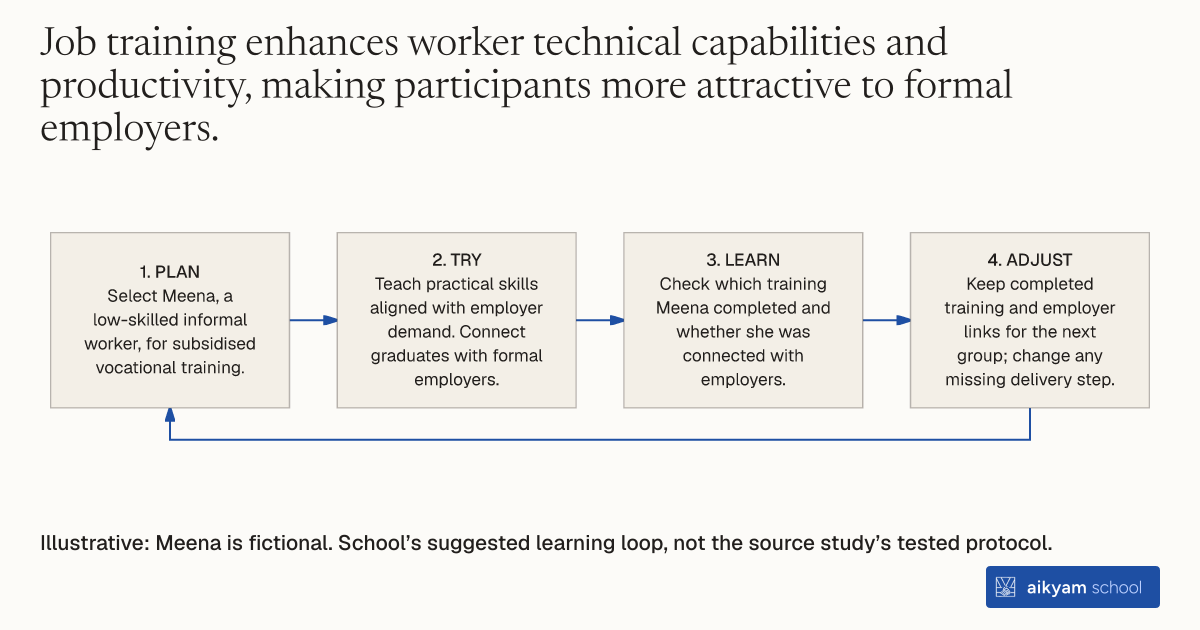
Try, learn and adjust
Check training and links to employers
- Plan: Select Meena, a low-skilled informal worker, for subsidised vocational training.
- Try: Teach practical skills aligned with employer demand. Connect graduates with formal employers.
- Learn: Check which training Meena completed and whether she was connected with employers.
- Adjust: Keep completed training and employer links for the next group; change any missing delivery step.
Illustrative: Meena is fictional. School’s suggested learning loop, not the source study’s tested protocol.
See source →School’s suggested, untested loop. Observe training completion and employer links; these checks do not establish employment effects.
How
When to use
Low-skilled workers lack technical competencies required by formal employers, trapping them in low-paying informal jobs. This situation restricts career mobility and limits access to social protection systems. It applies to labor ministries and vocational institutes seeking to improve workforce quality and formal employment rates.
Provide technical and vocational job training courses to increase worker skill levels and formal employability.
- Target low-skilled workers and job seekers operating in the informal economy.
- Design practical technical training curricula aligned with formal sector labor demand.
- Deliver subsidized classroom instruction and hands-on vocational skills training to course participants.
- Connect training graduates with formal sector employers and job placement opportunities.
Why it works
Increasing worker skill levels creates a direct pathway toward higher-quality, formal employment.
Example
In Brazil and Peru, job training programs increased the likelihood of participants securing formal jobs, demonstrating that vocational training enhances formal labor market participation.
Source
See source →Evidence in Labor Market Policies and Implications for Brazil: Informality
Copyright © 2025 Inter-American Development Bank.
Full source notice
Copyright © 2025 Inter-American Development Bank ("IDB"). This work is subject to a Creative Commons license CC BY 3.0 IGO (https://creativecommons.org/licenses/by/3.0/igo/legalcode). The terms and conditions indicated in the URL link must be met and the respective recognition must be granted to the IDB. Further to section 8 of the above license, any mediation relating to disputes arising under such license shall be conducted in accordance with the WIPO Mediation Rules. Any dispute related to the use of the works of the IDB that cannot be settled amicably shall be submitted to arbitration pursuant to the United Nations Commission on International Trade Law (UNCITRAL) rules. The use of the IDB's name for any purpose other than for attribution, and the use of IDB's logo shall be subject to a separate written license agreement between the IDB and the user and is not authorized as part of this license. Note that the URL link includes terms and conditions that are an integral part of this license.