Try, learn and adjust
Check psychosocial support accompanies cash
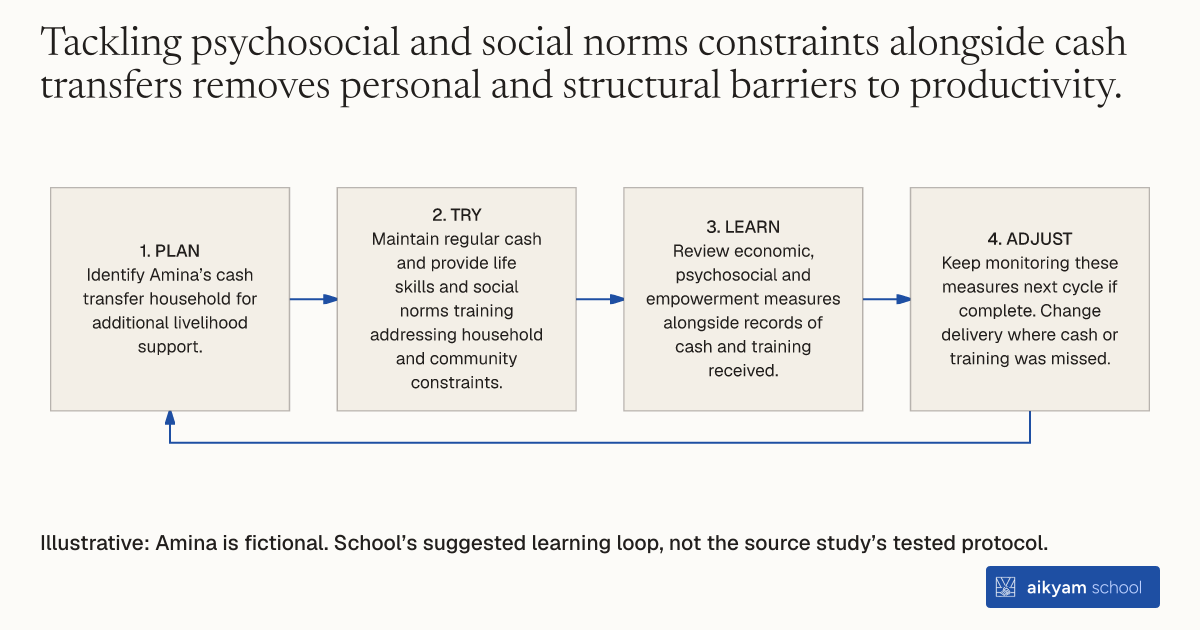
- Plan: Identify Amina’s cash transfer household for additional livelihood support.
- Try: Maintain regular cash and provide life skills and social norms training addressing household and community constraints.
- Learn: Review economic, psychosocial and empowerment measures alongside records of cash and training received.
- Adjust: Keep monitoring these measures next cycle if complete. Change delivery where cash or training was missed.
Illustrative: Amina is fictional. School’s suggested learning loop, not the source study’s tested protocol.
See source →School’s suggested, untested loop. Observe cash, training and the stated outcome measures; do not assume sustained impact from delivery alone.
How
When to use
Extreme poverty imposes heavy psychological stress and social constraints that cash transfers alone cannot fix. Unbundled asset transfers can also be expensive to implement at scale. Adding life skills and social norms support to existing cash transfers offers a cost-effective way to boost livelihoods for low-income families.
Integrate psychosocial support services directly onto a government cash transfer program for low-income households.
- Implementation teams identify cash transfer recipient households needing additional livelihood support.
- Program officers maintain regular cash transfer disbursements to establish baseline income stability.
- Facilitators conduct life skills training sessions to build personal resilience and decision-making skills.
- Field staff deliver social norms training to address household and community social constraints.
- Program staff monitor beneficiary economic, psychosocial, and empowerment outcomes to ensure sustained impact.
Why it works
This approach generates strong economic and social gains without incurring the high cost of transferring physical assets.
Example
In Niger, adding psychosocial supports including life skills and social norms training to a government cash transfer program proved highly cost-effective while improving economic, psychosocial, and women's empowerment measures.