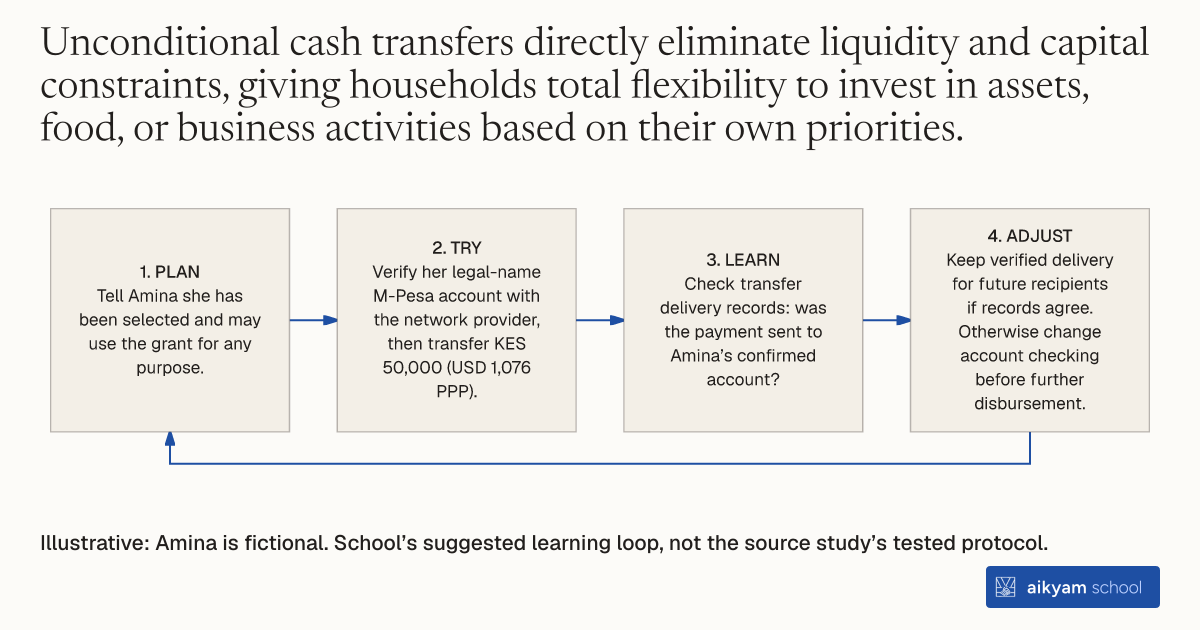
Try, learn and adjust
Check unconditional mobile cash reaches the verified account
- Plan: Tell Amina she has been selected and may use the grant for any purpose.
- Try: Verify her legal-name M-Pesa account with the network provider, then transfer KES 50,000 (USD 1,076 PPP).
- Learn: Check transfer delivery records: was the payment sent to Amina’s confirmed account?
- Adjust: Keep verified delivery for future recipients if records agree. Otherwise change account checking before further disbursement.
Illustrative: Amina is fictional. School’s suggested learning loop, not the source study’s tested protocol.
See source →School’s suggested learning loop, not a source-tested procedure. Observe account confirmation and transfer delivery; this is not a test of consumption or psychological effects.
How
When to use
Low-income households in developing regions often face severe liquidity constraints, while traditional physical grant distribution methods carry high administrative overhead and security risks. This method delivers large, non-repayable grants securely and remotely to poor individuals through mobile money platforms without imposing spending conditions. It serves development organizations seeking to increase household economic consumption and psychological well-being.
Deliver unconditional financial capital directly to low-income recipients through an established digital mobile money network.
- Field officers contact selected eligible participants over the phone or in person to inform them of their grant selection.
- Field officers explicitly emphasize to recipients that the cash transfer is entirely unconditional and available for any purpose.
- Field officers verify that each recipient holds an active digital payment account registered under their legal name on the local mobile network.
- Field managers confirm recipient account credentials directly with the mobile network provider prior to disbursing funds.
- Survey coordinators disburse an unconditional cash transfer of KES 50,000 (USD 1,076 PPP) directly into each confirmed recipient account via M-Pesa.
Why it works
Receiving direct capital grants improves both physical economic security and psychological well-being without imposing administrative compliance burdens.
Example
In rural Nakuru County, Kenya, Busara Center for Behavioral Economics delivered unconditional cash transfers of KES 50,000 (USD 1,076 PPP) via M-Pesa to 540 low-income households. One year later, recipient households achieved a USD 10.40 PPP (20 percent) increase in monthly consumption, a USD 272.16 PPP (49 percent) increase in asset holdings, and a 0.24 standard deviation increase in psychological well-being relative to control households.
About the study
Participants
5,756 low-income individuals across 233 rural villages in Nakuru County, Kenya, including 540 cash-only transfer recipients and 493 combined cash and psychotherapy recipients.
Study Design
A randomized controlled trial comparing an unconditional cash transfer of USD 1,076 PPP delivered via M-Pesa against pure control households at baseline and a 1-year endline survey.
Results
USD 1,076 PPP unconditional cash transfers increased monthly consumption by USD 10.40 PPP (20 percent), asset holdings by USD 272.16 PPP (49 percent), monthly revenue by USD 36.32 PPP (27 percent), and psychological well-being by 0.24 standard deviations relative to control households after one year.