Try, learn and adjust
Check reliable receipt of unconditional cash
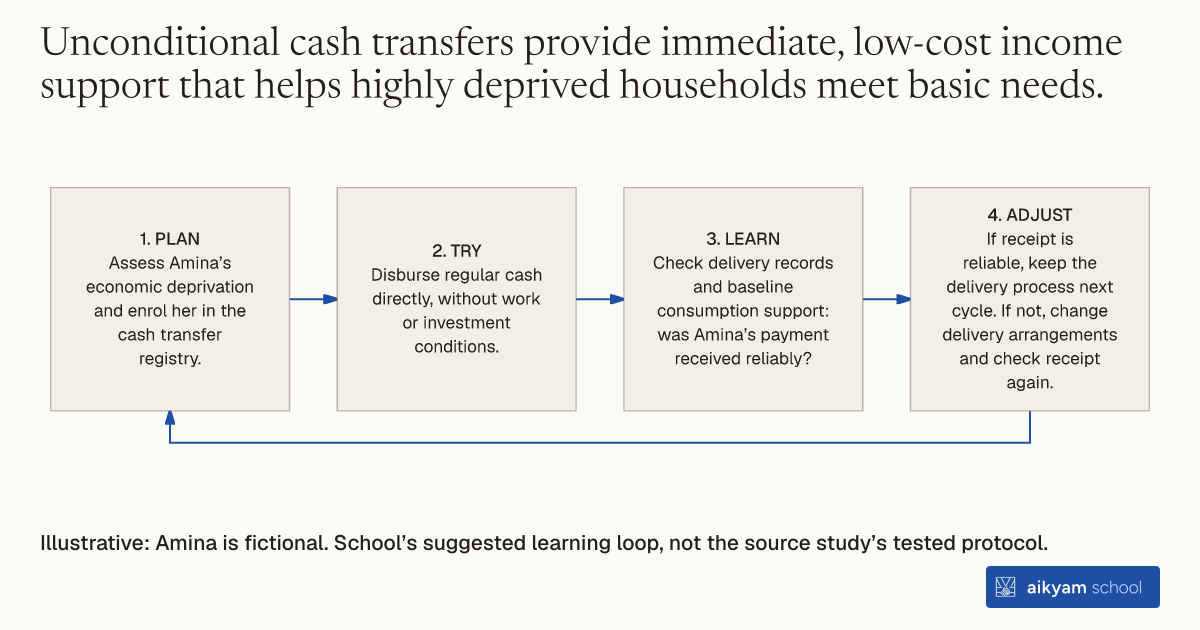
- Plan: Assess Amina’s economic deprivation and enrol her in the cash transfer registry.
- Try: Disburse regular cash directly, without work or investment conditions.
- Learn: Check delivery records and baseline consumption support: was Amina’s payment received reliably?
- Adjust: If receipt is reliable, keep the delivery process next cycle. If not, change delivery arrangements and check receipt again.
Illustrative: Amina is fictional. School’s suggested learning loop, not the source study’s tested protocol.
See source →Observe reliable payment receipt and basic consumption support. Do not assume cash replicates a multifaceted programme’s sustained effects.
How
When to use
Low-income households facing extreme deprivation need immediate consumption relief and economic support. Multifaceted livelihood interventions can be expensive and complex to scale across entire populations. Deploy simple unconditional cash transfers targeted to specific vulnerable individuals as part of a broader social protection portfolio.
Deliver direct unconditional cash transfers targeted to highly deprived individuals or households.
- Program managers evaluate population poverty levels to identify target recipients facing high economic deprivation.
- Field staff enroll selected low-income beneficiaries into the cash transfer registry.
- Implementation teams disburse regular cash payments directly to participants without conditional work or investment requirements.
- Program officers monitor transfer delivery to ensure reliable receipt and baseline consumption support.
Why it works
While cash transfers alone do not fully replicate the sustained impacts of multifaceted programs, targeting them within an overall policy portfolio optimizes resource allocation.
Example
In Kenya, an unconditional cash transfer evaluation provided direct cash support to poor households to measure consumption responses.