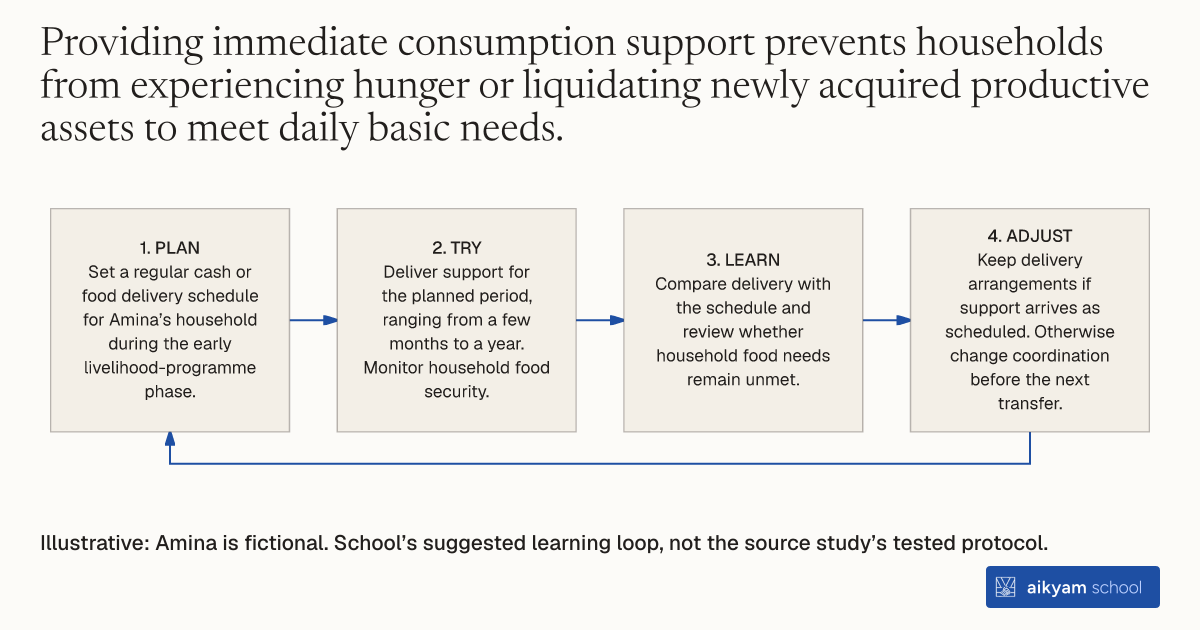
Try, learn and adjust
Check temporary support reaches households regularly
- Plan: Set a regular cash or food delivery schedule for Amina’s household during the early livelihood-programme phase.
- Try: Deliver support for the planned period, ranging from a few months to a year. Monitor household food security.
- Learn: Compare delivery with the schedule and review whether household food needs remain unmet.
- Adjust: Keep delivery arrangements if support arrives as scheduled. Otherwise change coordination before the next transfer.
Illustrative: Amina is fictional. School’s suggested learning loop, not the source study’s tested protocol.
See source →School’s suggested learning loop: observe support receipt and food security; the source’s consumption gains came from bundled support.
How
When to use
Extreme poverty leaves ultra-poor households with irregular or seasonal income, putting laborers and their families at risk of hunger. While waiting for newly acquired productive assets or enterprises to generate income, families face immediate consumption shortfalls. Deliver temporary cash or food stipends to stabilize short-term consumption for low-income households.
Provide regular cash or food transfers to ultra-poor households during the early phase of a livelihood program.
- Program managers establish a delivery schedule for regular consumption support payments or food transfers.
- Field staff distribute cash stipends or food support directly to enrolled households.
- Implementing teams maintain regular transfer schedules over a duration ranging from a few months up to one year.
- Program officers monitor household food security to ensure basic daily nutrition needs are met while new livelihoods take root.
Why it works
Protecting consumption creates the essential economic stability required for beneficiaries to invest time into building sustainable self-employment.
Example
Across twenty randomized evaluations, providing regular short-term consumption support as part of a bundled intervention helped ultra-poor beneficiaries increase overall consumption by 11 to 30 percent.