Try, learn and adjust
Check visible campaign coverage across wards
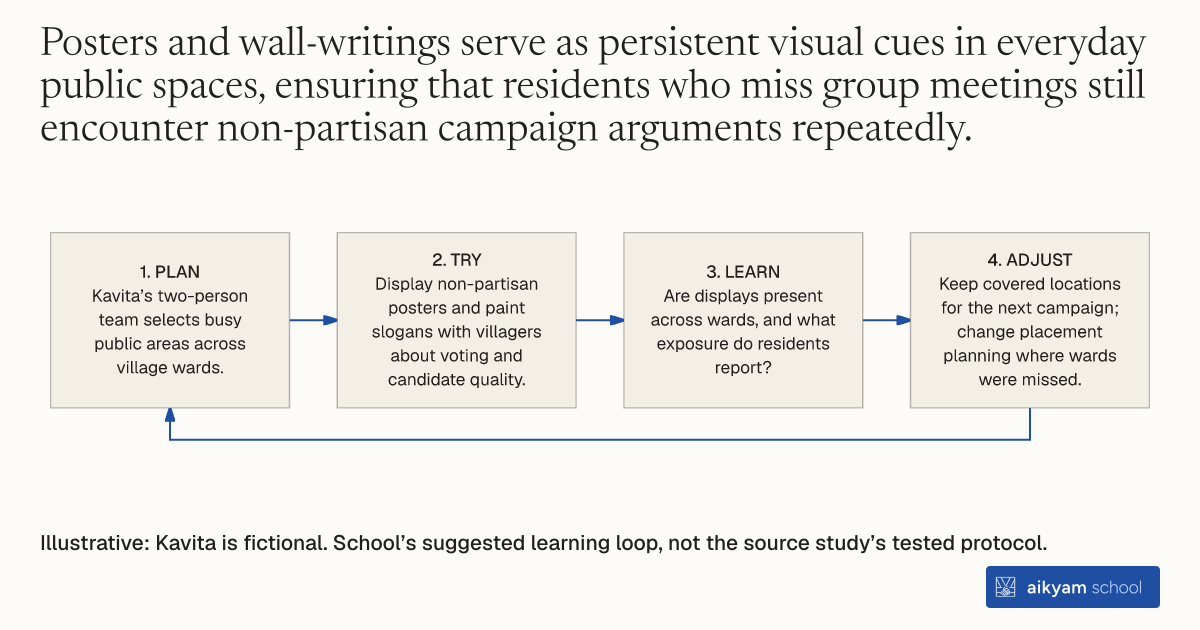
- Plan: Kavita’s two-person team selects busy public areas across village wards.
- Try: Display non-partisan posters and paint slogans with villagers about voting and candidate quality.
- Learn: Are displays present across wards, and what exposure do residents report?
- Adjust: Keep covered locations for the next campaign; change placement planning where wards were missed.
Illustrative: Kavita is fictional. School’s suggested learning loop, not the source study’s tested protocol.
See source →School’s suggested learning loop, not a tested source procedure. Observe display coverage and reported exposure; effects were measured for the larger campaign.
How
When to use
In rural democratic elections, voters often miss public meetings and rallies due to work, domestic duties, or mobility constraints. Public poster campaigning and wall-writing solve this by placing durable visual non-partisan messages on walls and public infrastructure throughout a village. This ensures high-visibility exposure to civic voting principles across all village wards.
Display non-partisan campaign posters and write slogans on public village walls to maintain visible civic messaging throughout an election campaign.
- Deploy a two-person NGO field team equipped with posters and paint during the morning session in a target village.
- Select high-traffic public areas across all village wards, including central meeting spots, market areas, and major walkways.
- Affix campaign posters prominently on public walls and buildings to inform residents about scheduled campaign activities and core messages.
- Paint non-partisan campaign slogans directly on village walls in collaboration with local villagers.
- Reinforce key messages discouraging caste-based voting or corrupt candidate selection through these static visual displays.
Why it works
Involving villagers in wall-writing also fosters community ownership over the non-partisan messaging.
Example
NGO field teams from Sarathi put up posters and painted wall slogans across treated villages in 36 polling-station clusters in rural Uttar Pradesh, India, during the 2007 state assembly election. Survey data showed an 8.7 percentage point increase in reported exposure to posters and wall-writings (rising from 17% in control to 25.7% in treatment villages), contributing to an intervention that increased male voter turnout by 11 percentage points.
About the study
Participants
The trial evaluated 36 polling-station clusters across Lalitpur, Bahraich, and Sitapur districts in rural Uttar Pradesh, India, surveying 1,538 Hindu respondents (including Scheduled Castes and Other Backward Castes).
Study Design
Researchers evaluated poster and wall-writing activities as part of a randomized cluster field experiment, measuring exposure via a post-election survey and estimating treatment effects using instrumental variables regressions.
Results
Survey results showed an 8.7 percentage point increase in reported exposure to posters and wall-writings in treated villages (point estimate 0.087; p < 0.1) over a 17% control baseline, contributing to an overall intervention that increased male turnout by 11 percentage points and reduced caste-preferred voting by 10 percentage points.