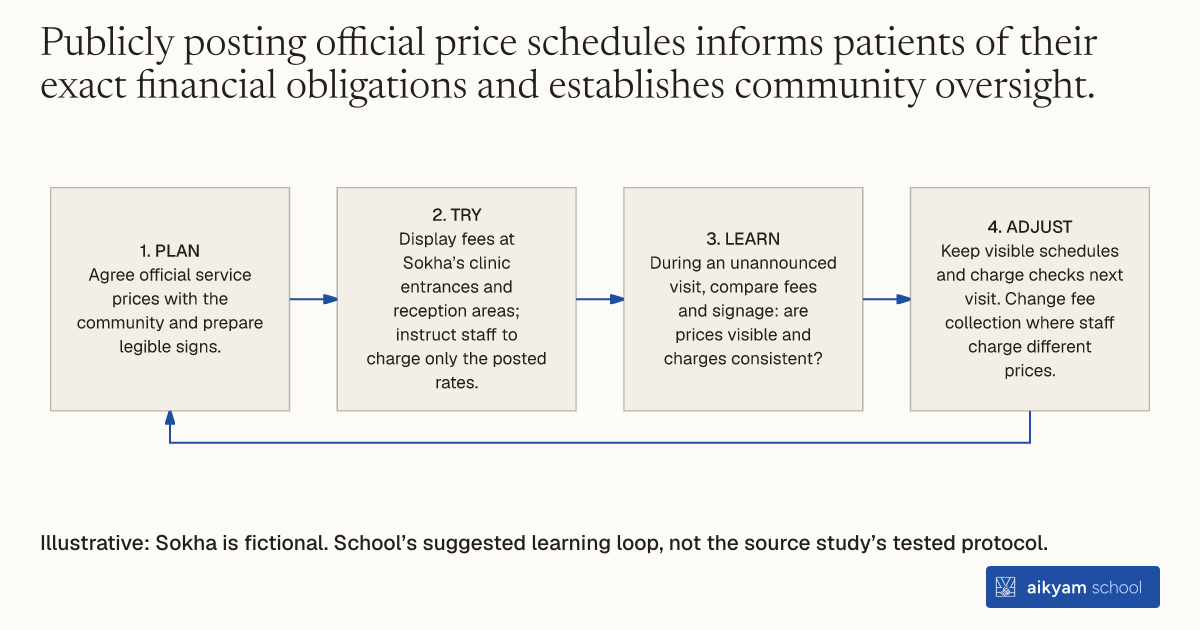
Try, learn and adjust
Check clinic charges match visible fee schedules
- Plan: Agree official service prices with the community and prepare legible signs.
- Try: Display fees at Sokha’s clinic entrances and reception areas; instruct staff to charge only the posted rates.
- Learn: During an unannounced visit, compare fees and signage: are prices visible and charges consistent?
- Adjust: Keep visible schedules and charge checks next visit. Change fee collection where staff charge different prices.
Illustrative: Sokha is fictional. School’s suggested learning loop, not the source study’s tested protocol.
See source →School’s suggested, untested loop. Observe posted prices, visibility and collected fees; do not infer that posting alone removed informal payments.
How
When to use
Public health clinics in rural areas often suffer from arbitrary or unauthorized price gouging by health facility staff. Without clear fee information, patients face unpredictable out-of-pocket costs and informal charges when seeking care. Display public price schedules prominently at health facilities to prevent staff overcharging and protect low-income patients.
Post clear official user-fee price schedules at public health facilities to standardize service charges and protect patients from informal fees.
- Define official prices for all primary health care services with local community consent.
- Produce legible price signage listing standardized fees for consultations, medical procedures, and medicines.
- Install price schedules prominently at the entrances and reception areas of all district health centers and hospitals.
- Instruct health facility staff and administrators to charge patients strictly according to the posted price schedules.
- Conduct unannounced supervisory visits to audit facility fee collection and verify that price listings remain visible to the public.
Why it works
Clear fee visibility prevents health workers from extracting unauthorized informal payments or overcharging for care.
Example
In rural Cambodia, district health management teams in contracted and comparison districts established user-fee systems and posted official price schedules at public health centers between 1999 and 2003. Public fee posting increased by 24 percentage points in contracting-in districts and 28 percentage points in contracting-out districts relative to the comparison average of 77%.
About the study
Participants
12 rural districts across Takeo, Prey Veng, and Kampong Cham provinces in Cambodia, covering 1.26 million residents across 360 sample villages with 3,700 households and 143 health centers.
Study Design
Cluster-randomized trial evaluating 12 districts randomly assigned to contracting out, contracting in, or comparison status, using initial random eligibility as an instrumental variable for actual contract rollout.
Results
Contracting in increased clear posting of user fees by 24 percentage points (statistically significant at 5% under clustering) and contracting out increased posting by 28 percentage points against a comparison mean of 77%.