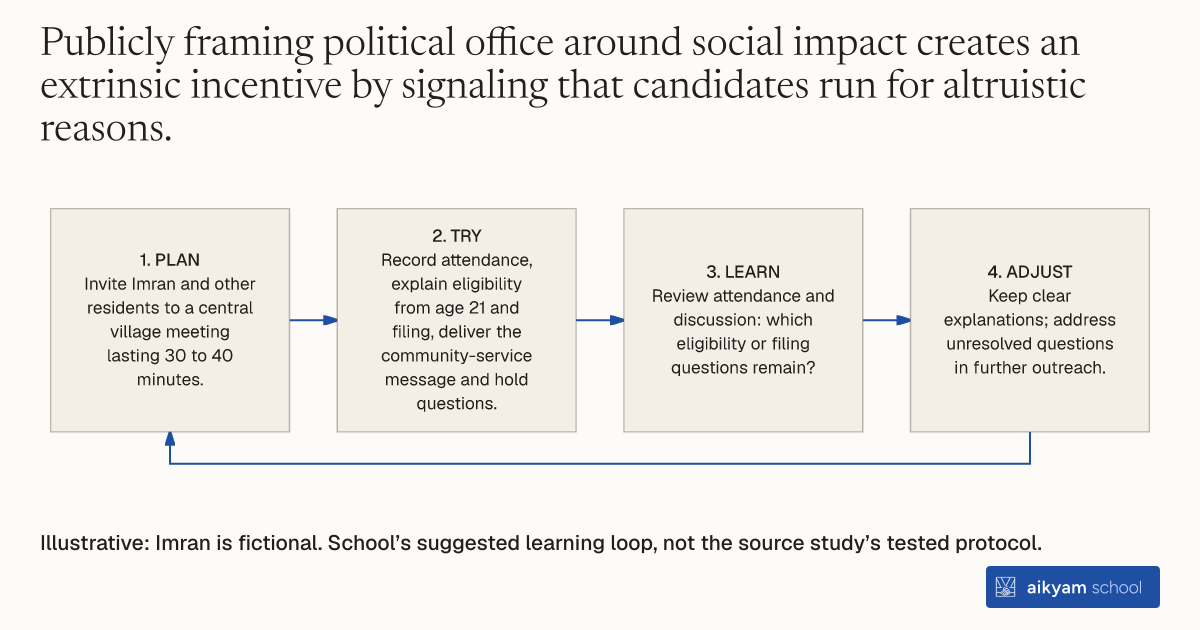
Try, learn and adjust
Check public outreach includes questions
- Plan: Invite Imran and other residents to a central village meeting lasting 30 to 40 minutes.
- Try: Record attendance, explain eligibility from age 21 and filing, deliver the community-service message and hold questions.
- Learn: Review attendance and discussion: which eligibility or filing questions remain?
- Adjust: Keep clear explanations; address unresolved questions in further outreach.
Illustrative: Imran is fictional. School’s suggested learning loop, not the source study’s tested protocol.
See source →School’s suggested loop, not a tested source procedure. Observe attendance and discussion; meeting participation does not establish election effects.
How
When to use
Selfish motives often dominate political entry, discouraging public-spirited citizens from running for local office. Publicly framing political candidacy around community service alters how citizens view candidates. This approach helps communities recruit civic-minded leaders for newly created local councils.
Organise public village meetings to deliver prosocial messages encouraging citizens to run for local political office.
- Select a central landmark in the village for a 30 to 40 minute public meeting.
- Invite randomly sampled household members and allow any interested village residents to attend.
- Record participant attendance as residents arrive at the meeting venue.
- Explain council structures, election timing, eligibility for adults aged 21 and above, and paper collection from the Election Commission.
- Deliver a prosocial script emphasizing that elected members receive an excellent opportunity to improve local schools, health facilities, and services for the poor.
- Facilitate open questions and discussion among participants before concluding the session.
Why it works
This social signal encourages prosocial individuals to enter the race and helps community members coordinate support around them.
Example
In Haripur and Abbottabad districts of Pakistan, field staff held public village meetings across local communities to encourage candidacy for new village councils. Delivering prosocial messages in public meetings increased the probability that sampled citizens ran for office by 2.2 percentage points and got elected by 1.1 percentage points compared to personal status messages.
About the study
Participants
9,310 male citizens across 192 villages in Haripur and Abbottabad districts, Khyber Pakhtunkhwa province, Pakistan.
Study Design
A randomized field experiment comparing public and private social, personal, and neutral encouragement treatments across 12 geographic blocks, analyzing candidate filing records, election results, and municipal budget data.
Results
Delivering social versus personal messages in public meetings increased candidacy by 2.2 percentage points (p = 0.043), increased election probability by 1.1 percentage points (p = 0.096), and decreased the Euclidean distance between official budget spending and citizen preferences by 18.219 points (p = 0.027).