Research steps
Measure fitness with stepping exercises
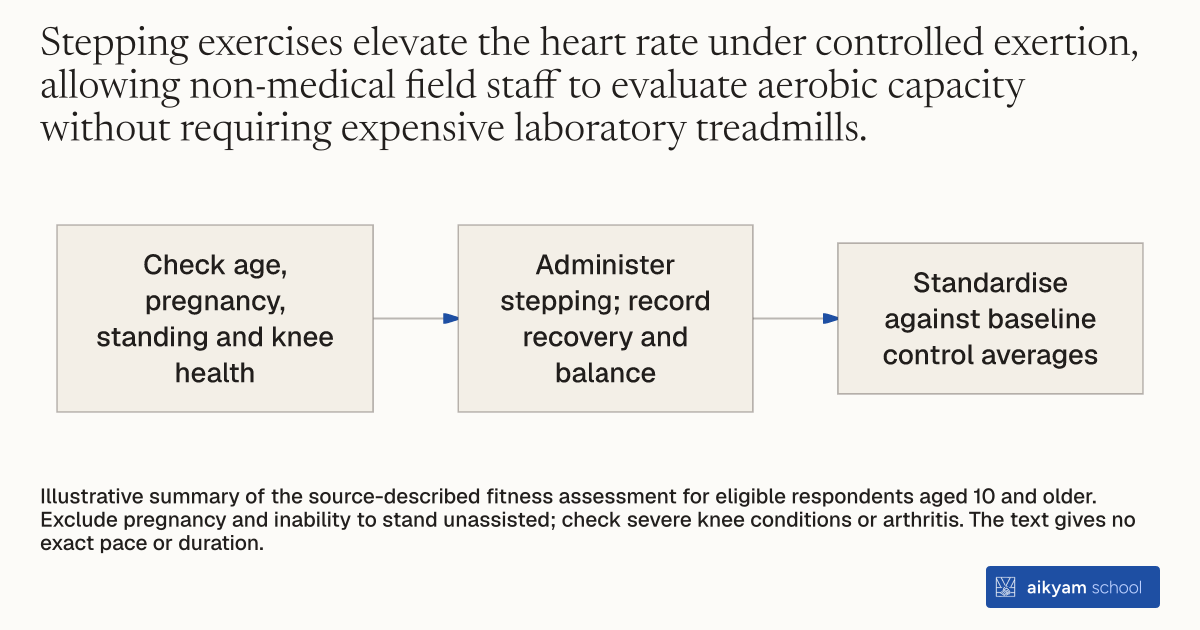
- Check age, pregnancy, standing and knee health
- Administer stepping; record recovery and balance
- Standardise against baseline control averages
Illustrative summary of the source-described fitness assessment for eligible respondents aged 10 and older. Exclude pregnancy and inability to stand unassisted; check severe knee conditions or arthritis. The text gives no exact pace or duration.
See source →How
When to use
Public health evaluations in low-resource settings need standardized tools to measure physical endurance and cardiorespiratory fitness. Iron deficiency anemia causes fatigue and weakens work capacity across rural populations. Administering step tests allows field survey staff to measure aerobic capacity and physical balance directly in village settings.
Measure individual aerobic capacity and physical fitness using standardized stepping exercises during household health surveys.
- Screen household participants aged 10 years and older who can stand unassisted and are not pregnant.
- Inspect participants for severe knee conditions or severe arthritis to determine eligibility for stepping exercises.
- Instruct eligible participants to step up and down on a standardized platform at a steady rhythmic pace for a specified duration.
- Record post-exercise heart rate recovery and balance performance to evaluate cardiovascular endurance.
- Standardize test results against baseline control group averages to construct unified physical fitness scores.
Why it works
Calculating post-exercise recovery scores provides an objective physical health metric across large rural study samples.
Example
Survey staff administered physical fitness tests, including the Queen's Step Test, to 15,607 eligible participants aged 10 and older across rural study villages in Bhojpur district, Bihar. Physical fitness scores in double-fortified salt sales villages changed by -0.001 standard deviations compared to control villages, showing no significant improvement.
About the study
Participants
15,607 individuals aged 10 years and older who were non-pregnant and able to stand unassisted, across 400 rural villages in Bhojpur district, Bihar.
Study Design
Survey teams evaluated aerobic capacity and balance using the Queen's Step Test during endline household surveys across sales treatment, free distribution, and control villages.
Results
Physical fitness scores showed an statistically insignificant change of -0.001 standard deviations in sales villages (95% CI: -0.064 to +0.062 SD) and -0.061 standard deviations in free DFS households (95% CI: -0.173 to +0.051 SD).