Research procedure
Test vouchers for collecting HIV results
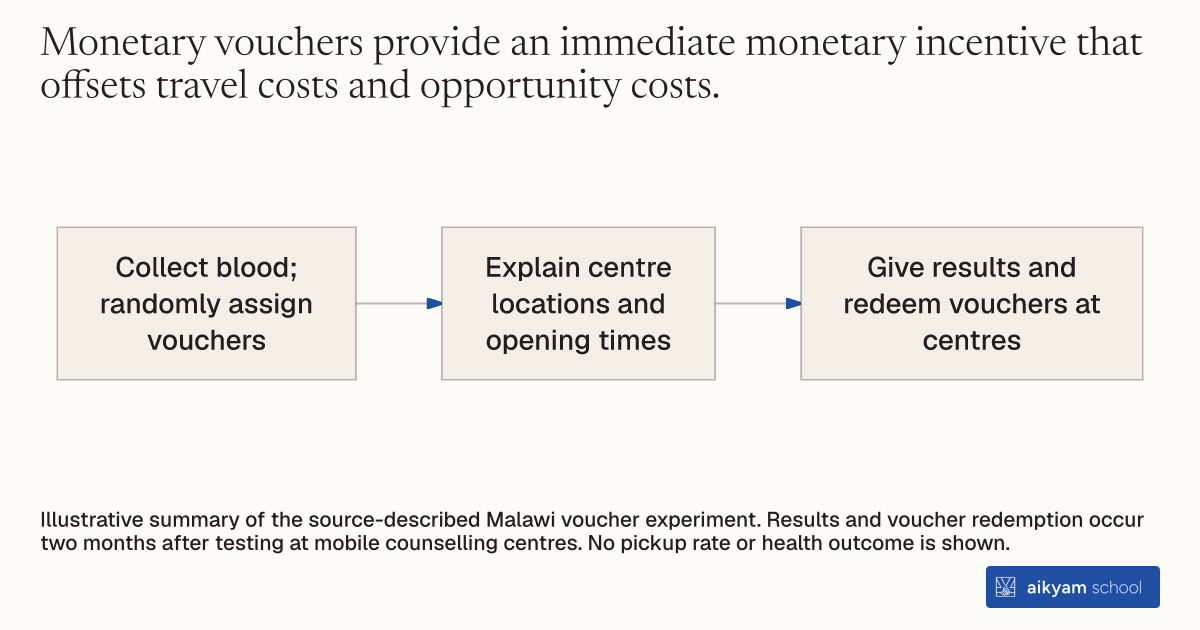
- Collect blood; randomly assign vouchers
- Explain centre locations and opening times
- Give results and redeem vouchers at centres
Illustrative summary of the source-described Malawi voucher experiment. Results and voucher redemption occur two months after testing at mobile counselling centres. No pickup rate or health outcome is shown.
See source →How
When to use
Many individuals in low-income rural areas take health tests but never pick up their results. Travel distance and fear of bad news prevent people from learning their health status. Random monetary vouchers provide an immediate financial reward that encourages rural residents to attend local clinics and collect their test results.
Assign random monetary vouchers to individuals after health testing to incentivize test result collection.
- Field staff conduct door-to-door HIV testing and collect blood samples from participants in rural villages.
- Field staff draw random monetary vouchers worth between one and three dollars for each tested participant.
- Field staff inform participants of the location and opening times of their assigned mobile results center.
- Clinic staff set up mobile counseling centers in villages two months after taking blood samples.
- Clinic staff give participants their test results and redeem their cash vouchers when participants visit the center.
Why it works
This small financial reward overcomes procrastination and psychological barriers to learning health status.
Example
Researchers tested 2,894 individuals for HIV in rural Malawi and offered 2,834 of them randomly assigned monetary vouchers worth about one dollar on average. Two months later, 86 percent of individuals offered incentives walked to local mobile centers to learn their results and redeem their cash.
About the study
Participants
2,834 adults offered incentives across 125 rural villages in Malawi, with 41 percent male, an average age of 35 years, and 4.9 years of education.
Study Design
Randomized field experiment where tested participants received randomly assigned vouchers redeemable upon picking up test results at mobile centers placed at varying distances.
Results
Receiving any monetary incentive increased result pickup by 33.6 percentage points for HIV-negative individuals and 23.6 percentage points for HIV-positive individuals, with each additional dollar increasing pickup by 8.8 percentage points.