Research allocation
Randomise immediate training admission
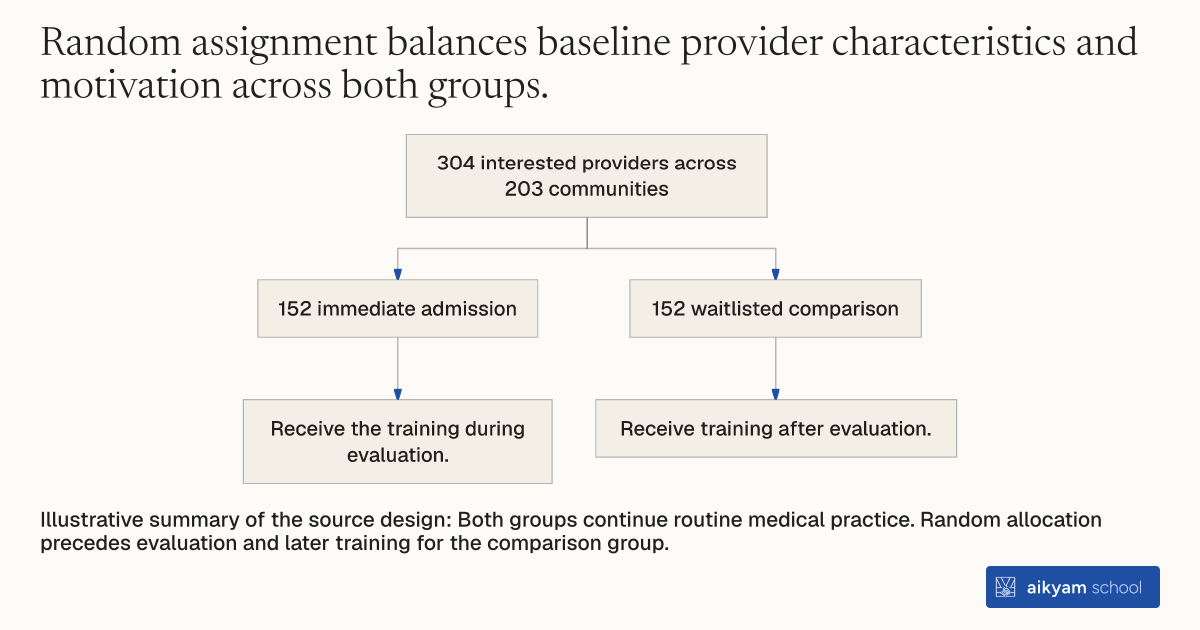
304 interested providers across 203 communities
- 152 immediate admission
- Receive the training during evaluation.
- 152 waitlisted comparison
- Receive training after evaluation.
Illustrative summary of the source design: Both groups continue routine medical practice. Random allocation precedes evaluation and later training for the comparison group.
See source →How
When to use
In rural areas, informal health workers deliver most primary care, but evaluating training programs requires separating training effects from provider self-selection. Simply comparing volunteers to non-volunteers can bias results because motivated practitioners might perform better regardless of training. Assigning interested applicants randomly to immediate or waitlisted training provides a clear baseline to isolate the true impact of instruction.
Allocate half of all interested informal providers to immediate training while placing the remaining half in a waitlisted comparison group.
- Gather expressions of interest from practicing informal healthcare providers across target villages.
- Select half of the interested providers at random to receive immediate admission to the training course.
- Assign the unselected half of providers to a comparison group that receives no immediate instruction.
- Allow both groups to continue operating their routine medical practices during the evaluation period.
- Offer the complete training program to the comparison group after evaluation activities conclude.
Why it works
This structure ensures that performance differences after training stem directly from the course rather than pre-existing practitioner traits.
Example
Across 203 communities in West Bengal, India, researchers enrolled 304 interested informal providers and randomly selected 152 for immediate training while placing 152 in a comparison group.
About the study
Participants
304 informal healthcare providers across 203 communities in West Bengal, India.
Study Design
Randomized evaluation dividing interested informal providers into an immediate training treatment group and a waitlisted comparison group.
Results
Half of the 304 interested providers received immediate admission, enabling researchers to attribute an 8 percentage point increase in correct case management directly to the training.