Research steps
Randomly invite auction providers
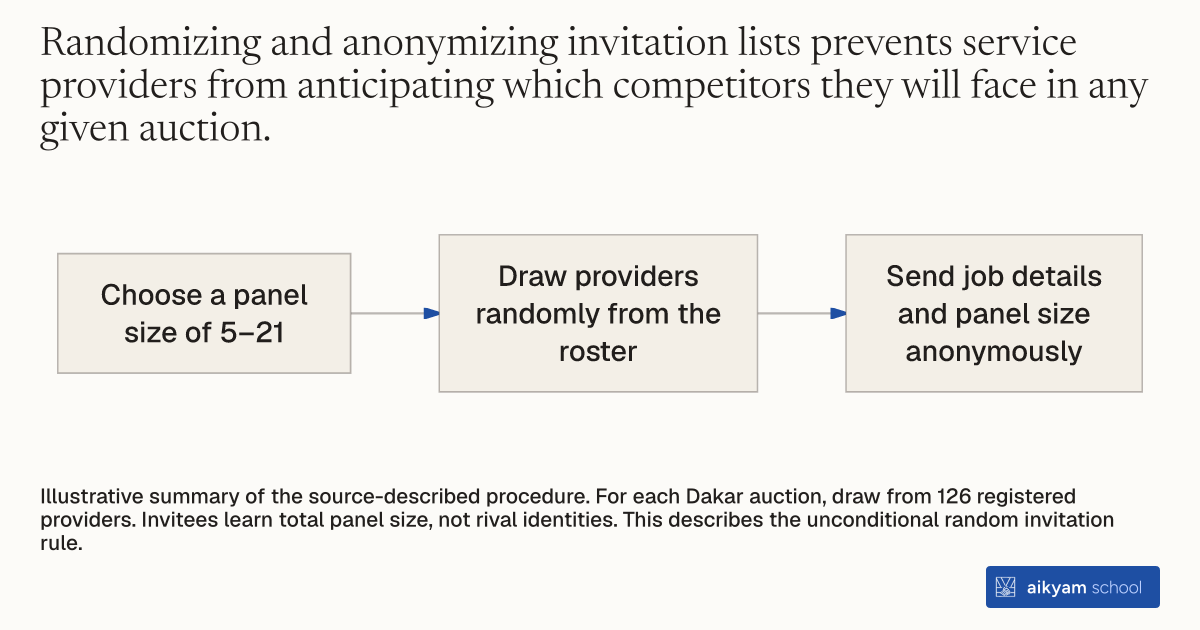
- Choose a panel size of 5–21
- Draw providers randomly from the roster
- Send job details and panel size anonymously
Illustrative summary of the source-described procedure. For each Dakar auction, draw from 126 registered providers. Invitees learn total panel size, not rival identities. This describes the unconditional random invitation rule.
See source →How
When to use
Public procurement platforms need to randomize bidder panel composition to prevent price coordination among service providers. The method addresses tacit collusion and cartel price-fixing by varying bidder panel sizes and anonymizing invited provider identities for each job request. It is designed for platform managers and researchers evaluating competition dynamics in decentralized utility markets.
Randomly select a subset of registered service providers to participate in each procurement auction while withholding bidder identities.
- Platform managers register all active commercial service operators in the metropolitan area into a central platform roster.
- The platform's automated system randomly determines the target panel size between 5 and 21 bidders when a household submits a job request.
- The platform randomly draws that target number of service providers from the complete roster of registered operators.
- Call center dispatchers send text-message job invitations to the randomly selected providers specifying job details and total invited panel size.
- Dispatchers withhold the specific identities of invited rivals to prevent direct pre-auction communication or coordination among bidders.
Why it works
Without knowing rival identities or facing fixed groups of competitors, providers cannot coordinate bids or enforce cartel discipline on specific job offers.
Example
Researchers and platform operators in Dakar, Senegal randomly selected panels of between 5 and 21 vacuum truck operators from 126 registered providers for each desludging auction. Across 3,627 valid auctions, varying panel sizes and unconditionally randomizing provider invitations anonymized rival participation and enabled causal evaluation of bidder competition on winning prices.
About the study
Participants
126 registered vacuum truck operators invited across 3,627 valid procurement auctions (and 5,331 total auctions) in peri-urban residential neighborhoods of Dakar, Senegal.
Study Design
Randomized field trial platform feature evaluating randomly assigned panel sizes (between 5 and 21 invited bidders per auction) and unconditionally randomized bidder draw rules across sealed-bid and revisable-bid auction formats.
Results
Unconditionally randomizing provider invitations resulted in an average panel size of 12.73 invited bidders per auction (decreasing from 14 in the early phase to 11 in the late phase), with each registered operator receiving an average of 453.0 auction invitations and yielding an average winning price of 25,730 CFA.