Try, learn and adjust
Check missed-dose alerts receive home follow-up
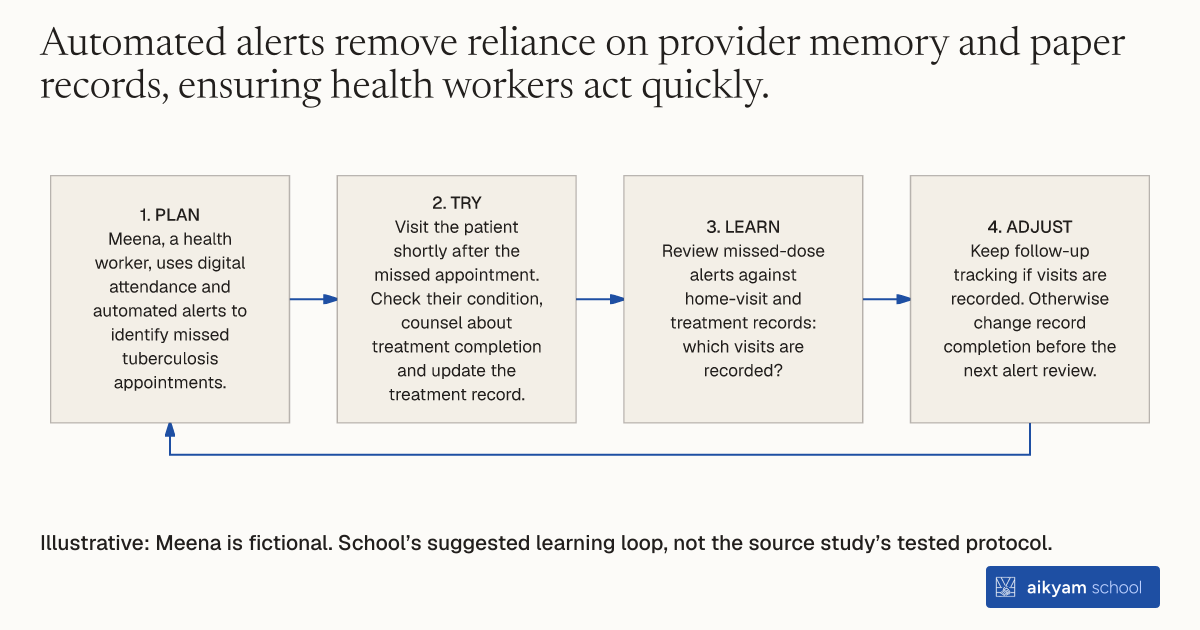
- Plan: Meena, a health worker, uses digital attendance and automated alerts to identify missed tuberculosis appointments.
- Try: Visit the patient shortly after the missed appointment. Check their condition, counsel about treatment completion and update the treatment record.
- Learn: Review missed-dose alerts against home-visit and treatment records: which visits are recorded?
- Adjust: Keep follow-up tracking if visits are recorded. Otherwise change record completion before the next alert review.
Illustrative: Meena is fictional. School’s suggested learning loop, not the source study’s tested protocol.
See source →School’s suggested learning loop: observe alerts, home visits and updated records; it is not advice to change prescribed dose timing.
How
When to use
Tuberculosis patients frequently miss scheduled treatment doses due to side effects, access barriers, or stigma. Unmonitored missed doses can lead patients to drop out of treatment entirely or develop drug resistance. Conducting rapid home visits whenever a dose is missed ensures health workers locate non-compliant patients and restore adherence immediately.
Conduct immediate home visits to patients who fail to show up for scheduled tuberculosis medication doses.
- Log patient attendance digitally at the treatment center during daily dispensing hours.
- Receive automated system alerts identifying patients who failed to attend and take their prescribed dose.
- Travel to the address of the non-compliant patient shortly after the missed appointment.
- Check on the patient's condition and counsel them on the necessity of completing treatment.
- Administer the overdue medication dose directly and update the patient's treatment record.
Why it works
Direct contact at the patient's home addresses individual compliance obstacles and prevents temporary dose skipping from turning into full treatment default.
Example
Operation ASHA health providers conducted rapid home visits for tuberculosis patients across 34 treatment centers in India, increasing follow-up visits after missed doses.
About the study
Participants
141 healthcare workers across 65 catchment areas in Madhya Pradesh, Punjab, Delhi, Uttar Pradesh, Chhattisgarh, and Orissa (Bhubaneshwar), India.
Study Design
Randomized controlled trial assigning 34 catchment areas to biometric tracking with automated alerts and 31 catchment areas to standard paper tracking over a 12 to 14 month evaluation period.
Results
Home visits to patients who missed their dosages increased by 32 percent (about 4 percentage points) in the biometric group, contributing to a reduction in treatment default rates from 7.3 percent to 1.8 percentage points.