Try, learn and adjust
Check bonus payments use verified receipts
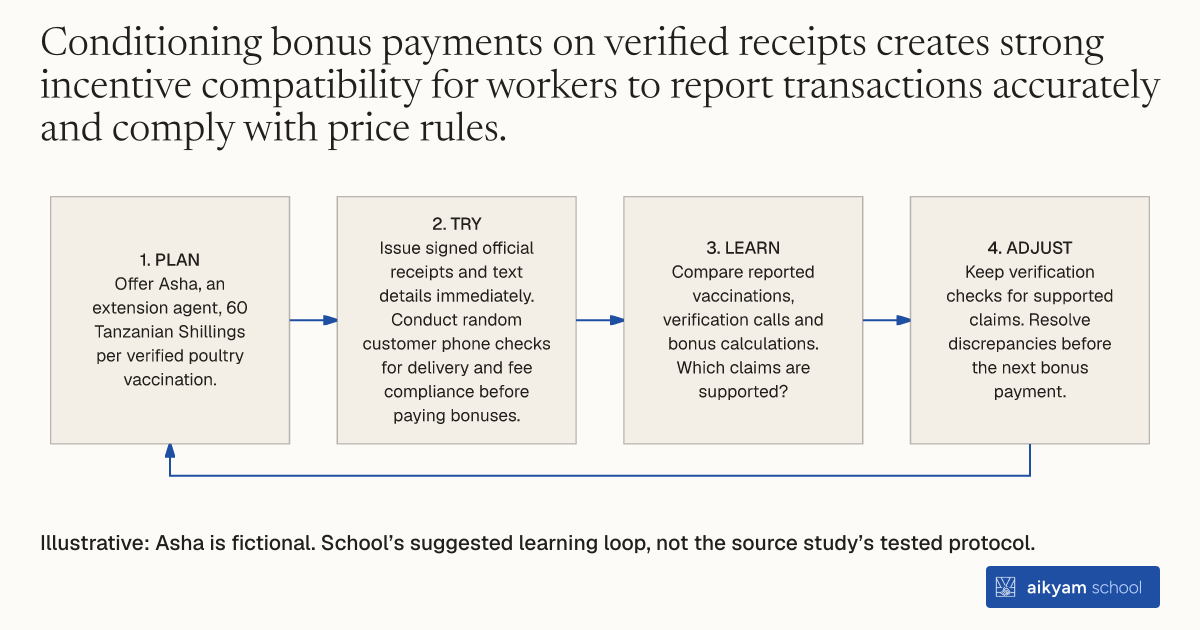
- Plan: Offer Asha, an extension agent, 60 Tanzanian Shillings per verified poultry vaccination.
- Try: Issue signed official receipts and text details immediately. Conduct random customer phone checks for delivery and fee compliance before paying bonuses.
- Learn: Compare reported vaccinations, verification calls and bonus calculations. Which claims are supported?
- Adjust: Keep verification checks for supported claims. Resolve discrepancies before the next bonus payment.
Illustrative: Asha is fictional. School’s suggested learning loop, not the source study’s tested protocol.
See source →School’s suggested, untested loop: observe receipt submissions, verification and fee compliance. The source describes a 15% random phone survey, not calls to every recipient.
How
When to use
Frontline public workers often lack accountability when delivering decentralized services in remote regions. Fixed salaries provide no incentive for effort, while performance pay based on self-reported activity encourages reporting fraud. This method applies when governments want to motivate service workers while ensuring honest reporting and regulatory compliance.
Condition frontline worker output bonus payments on verified receipt submissions to align worker effort with regulatory compliance.
- Ministry supervisors establish a per-unit performance bonus paid directly to service agents for each verified output.
- Training staff supply agents with official serialized paper receipts stamped with the government emblem prior to a delivery campaign.
- Service agents issue a signed receipt to recipients for every transaction, recording recipient name, phone number, village, date, fee, and service quantity.
- Service agents transmit receipt details to a central database via mobile text messages immediately after service provision.
- Central administrators conduct random phone verification calls with recipients to confirm service delivery and fee compliance before issuing bonus payments.
Why it works
The financial bonus offsets potential gains from overcharging recipients while ensuring that reporting transactions remains more profitable than hiding them.
Example
The Ministry of Agriculture, Livestock and Fisheries in Tanzania offered a bonus of 60 Tanzanian Shillings per verified poultry vaccination to 832 extension agents across 550 administrative wards. Agents submitted 31,657 valid text-message receipts covering 702,762 vaccinations, and phone audits verified 69% of reported transactions, maintaining high price-cap compliance with only 4.5% non-compliance detected.
About the study
Participants
832 frontline government livestock extension agents and 3,580 verified smallholder farmers across 550 administrative wards in 27 districts of Tanzania (Dodoma, Iringa, Morogoro, and Tanga regions).
Study Design
Randomized field evaluation of a 60 Tanzanian Shillings per-vaccination output bonus conditioned on submitting official paper receipts via mobile text messages, audited through a 15% random phone survey of recipients.
Results
Offering the 60 Tanzanian Shillings bonus payment achieved receipt verification rates of 69% across experimental arms and limited price-cap non-compliance to 4.5% of treatment group transactions. In the control group, the bonus scheme supported average outputs of 1,154.47 vaccinations per agent and total collected revenue of 76,118 Tanzanian Shillings, while generating less than 4% receipt rejection due to missing phone numbers.