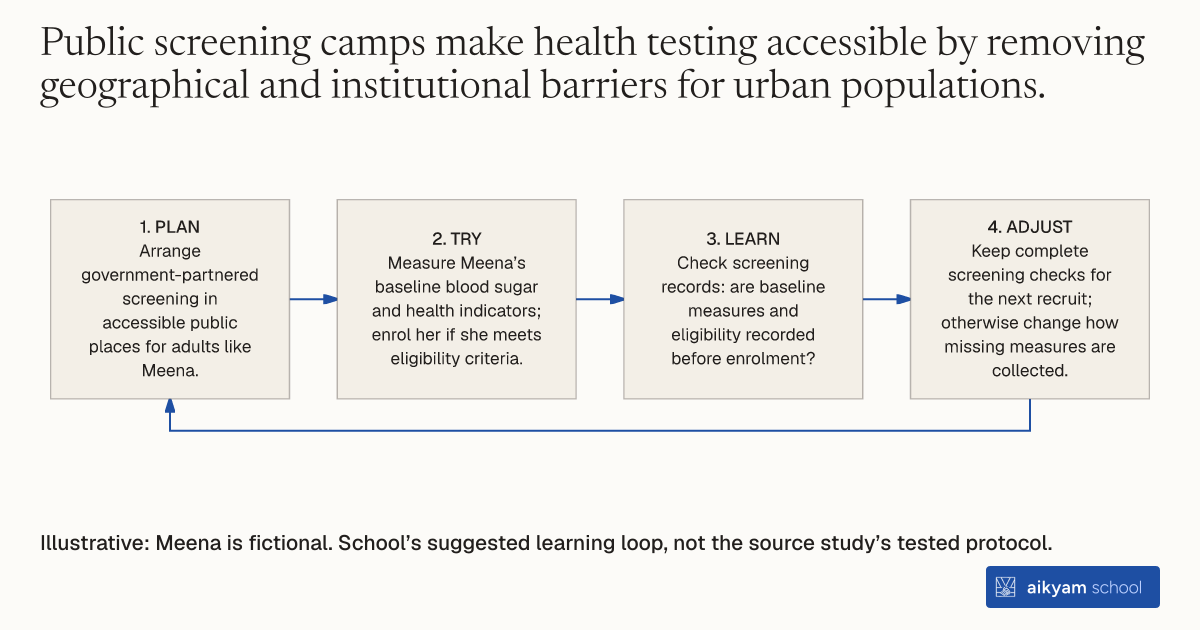
Try, learn and adjust
Check screening and enrolment
- Plan: Arrange government-partnered screening in accessible public places for adults like Meena.
- Try: Measure Meena’s baseline blood sugar and health indicators; enrol her if she meets eligibility criteria.
- Learn: Check screening records: are baseline measures and eligibility recorded before enrolment?
- Adjust: Keep complete screening checks for the next recruit; otherwise change how missing measures are collected.
Illustrative: Meena is fictional. School’s suggested learning loop, not the source study’s tested protocol.
See source →School’s suggested, untested learning loop. Observe baseline measurements, eligibility and enrolment records; this is not a clinical protocol.
How
When to use
Many urban residents in low- and middle-income countries live with undiagnosed or unmanaged diabetes and prediabetes. Health programs need effective ways to identify and enroll these individuals into health modification studies or interventions. Setting up public screening camps in everyday community locations reaches individuals directly where they live and work.
Set up screening camps in accessible public places to recruit diabetic and prediabetic adults into health programs.
- Form a partnership between researchers and local government health authorities.
- Select high-traffic public locations including government hospitals, markets, religious institutions, and parks in target cities.
- Conduct health screening camps at these venues to identify adults with doctor-diagnosed diabetes or elevated blood sugar.
- Measure participants' baseline blood sugar levels and collect baseline health indicators.
- Enroll eligible adults who meet the criteria into the program.
Why it works
Partnering with local governments and placing camps in high-traffic community spaces builds trust and yields high participant enrollment.
Example
Researchers partnered with the Government of Tamil Nadu in Coimbatore, India, and successfully recruited 3,192 individuals with diabetes or elevated blood sugar from public screening camps held at hospitals, markets, religious institutions, and parks.
About the study
Participants
3,192 adults in Coimbatore, India, averaging 49 years old, where 67 percent had doctor-diagnosed diabetes, 82 percent had elevated HbA1c, 49 percent had hypertension, and 61 percent had obesity.
Study Design
A randomized controlled trial evaluating physical activity incentives and step-monitoring contracts among recruited adults across eight intervention and comparison groups over twelve weeks.
Results
Recruiting through public screening camps yielded a sample of 3,192 participants, enabling researchers to test incentive contracts that increased daily target compliance by 20 percentage points and walking by 1,266 steps per day.