Try, learn and adjust
Align delivery promises with factory capacity
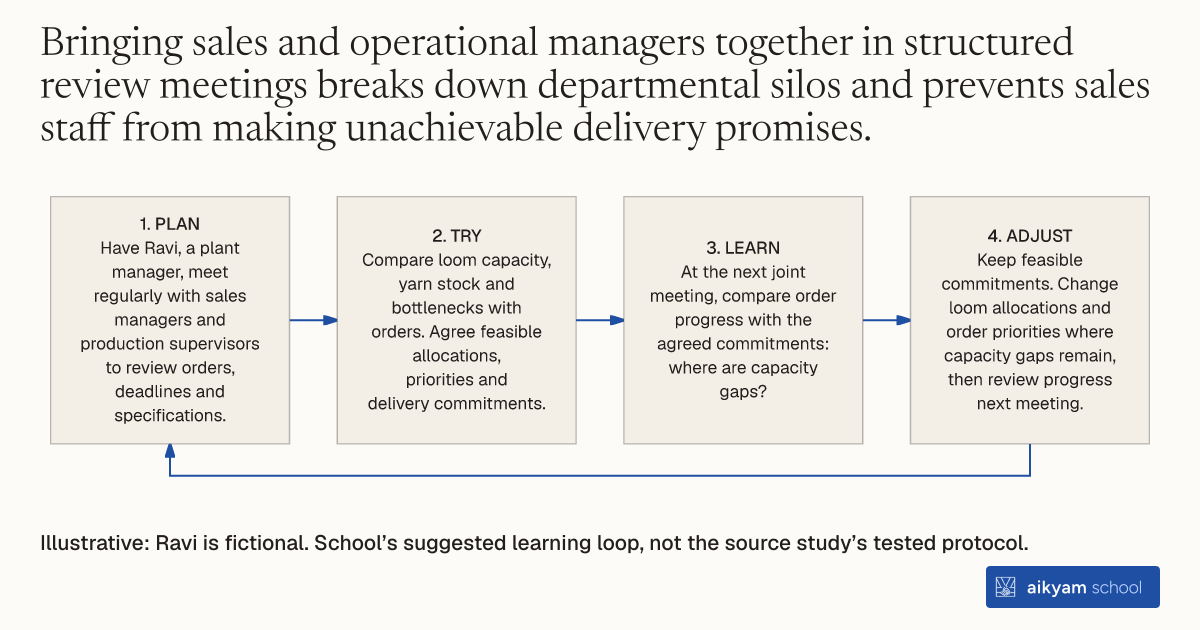
- Plan: Have Ravi, a plant manager, meet regularly with sales managers and production supervisors to review orders, deadlines and specifications.
- Try: Compare loom capacity, yarn stock and bottlenecks with orders. Agree feasible allocations, priorities and delivery commitments.
- Learn: At the next joint meeting, compare order progress with the agreed commitments: where are capacity gaps?
- Adjust: Keep feasible commitments. Change loom allocations and order priorities where capacity gaps remain, then review progress next meeting.
Illustrative: Ravi is fictional. School’s suggested learning loop, not the source study’s tested protocol.
See source →School’s suggested, untested loop: observe order progress, capacity and delivery commitments; improved delivery is not assumed.
How
When to use
Manufacturing facilities frequently suffer from misalignment between commercial sales teams and shop-floor production management, leading to uncoordinated loom schedules, late customer deliveries, or stockpiled unsold inventory. Establishing structured, regular joint meetings between sales and operational leaders aligns production capacity with client order specifications. This method helps firm owners and senior managers streamline order fulfillment and improve customer responsiveness.
Mandate regular joint coordination meetings between sales representatives and operational plant managers to align production schedules with market demand.
- Schedule recurring joint management meetings bringing together sales managers, plant managers, and production supervisors.
- Review active customer fabric orders, delivery deadlines, and specialized client specifications during each joint session.
- Compare current shop-floor loom capacity, yarn inventory balances, and production bottlenecks against incoming client order volumes.
- Adjust loom allocation schedules and prioritize high-margin or time-sensitive customer orders based on operational feasibility.
- Record agreed delivery commitments and follow up on order progress during subsequent joint management meetings.
Why it works
Aligning commercial order commitments directly with shop-floor loom capacity ensures realistic scheduling and reduces costly customer delivery delays.
Example
During the 2008–2010 management trial in Indian weaving plants near Mumbai, international consultants introduced regular meetings between sales and operational management. Adoption of regular joint sales-operations meetings increased from 50% across treatment plants in 2008 to 60% in 2011, before settling at 45% in 2017.
About the study
Participants
28 manufacturing plants across 17 family-owned cotton weaving firms near Mumbai, India, averaging 270 employees, $8.5 million in assets, and $7.5 million in annual sales.
Study Design
Randomized Controlled Trial (RCT) tracking 38 management practices across treatment and control plants from 2008 to 2017.
Results
Regular joint sales and operational management meeting adoption increased from 50% in 2008 to 60% in 2011 before declining to 45% in 2017, reflecting operational churn alongside long-term persistence in overall management practice gaps.