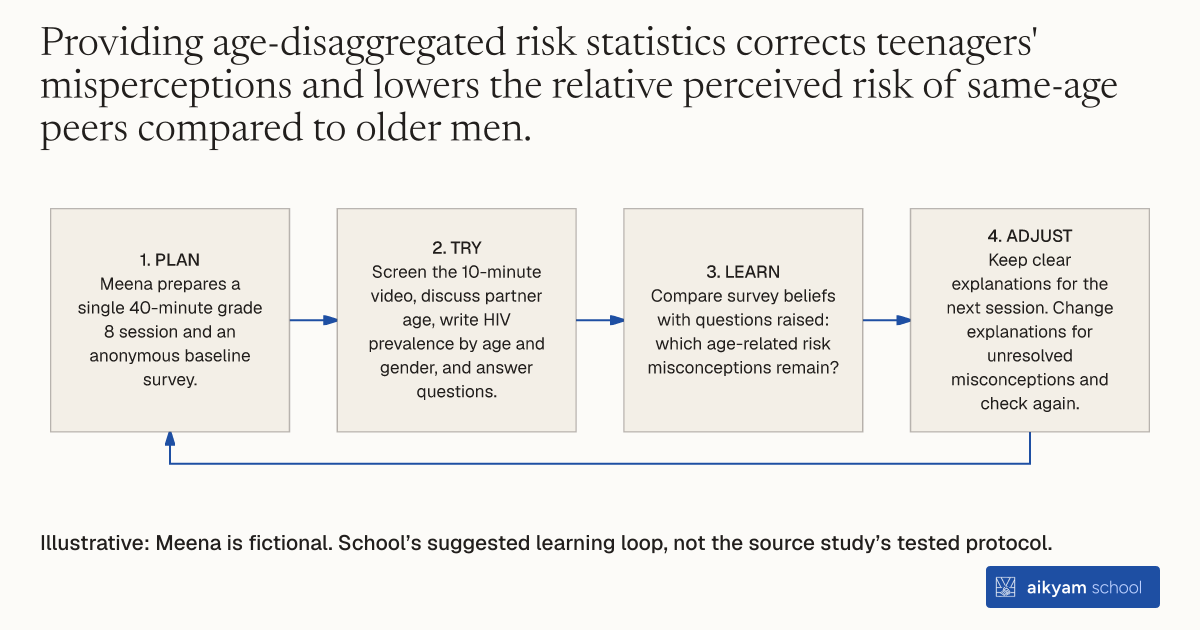
Try, learn and adjust
Check delivery of the relative risk session
- Plan: Meena prepares a single 40-minute grade 8 session and an anonymous baseline survey.
- Try: Screen the 10-minute video, discuss partner age, write HIV prevalence by age and gender, and answer questions.
- Learn: Compare survey beliefs with questions raised: which age-related risk misconceptions remain?
- Adjust: Keep clear explanations for the next session. Change explanations for unresolved misconceptions and check again.
Illustrative: Meena is fictional. School’s suggested learning loop, not the source study’s tested protocol.
See source →Observe prior beliefs and pupil questions. School suggests this learning loop; do not infer pregnancy effects from this check.
How
When to use
Teenage girls in developing regions face high HIV risks when engaging in cross-generational partnerships with older adult men. Standard abstinence education emphasizes overall epidemic risk but fails to inform youth about the sharp age-graded distribution of infection. This intervention provides eighth-grade primary students with detailed relative risk data by age and gender to reduce unsafe cross-generational partnerships.
Deliver a 40-minute classroom campaign that informs upper-primary students about age- and gender-disaggregated HIV prevalence to encourage safer partner selection.
- NGO project officers visit primary school grade 8 classrooms for a single 40-minute educational session.
- Officers administer a short anonymous baseline survey assessing students' prior beliefs regarding HIV infection distribution across age groups.
- Facilitators screen a 10-minute animated video depicting the financial traps and social dynamics of sugar daddy relationships.
- Project officers lead an open classroom discussion on cross-generational sex risks and present local research findings from regional epidemiological studies.
- Officers write detailed HIV prevalence statistics disaggregated by gender and age group on the classroom blackboard.
- Facilitators answer student questions scientifically, including inquiries about condom efficacy, without distributing materials or demonstrating condom usage.
Why it works
This encourages teenage girls to substitute away from older, high-risk partners toward lower-risk same-age partners or condom-protected relationships.
Example
In 71 primary schools in Western Kenya, an NGO project officer delivered the 40-minute relative risk campaign to grade 8 students in 2004. Over the following year, teenage pregnancy dropped by 28 percent, driven by a 61 percent decrease in pregnancies fathered by men more than five years older.
About the study
Participants
71 treatment primary schools and 257 comparison primary schools in Western Kenya, covering grade 8 primary students with an average age of 15 years.
Study Design
A randomized controlled trial evaluated the campaign by measuring 12-month teen childbearing incidence and partner age gaps via school assembly tracking and home follow-up surveys, alongside a secondary school behavioral survey.
Results
The campaign reduced overall teenage pregnancy rates by 28 percent (1.5 percentage points off a 5.4 percent control baseline) and reduced pregnancies fathered by men over five years older by 61.7 percent, while increasing condom use at last intercourse among secondary girls by 32 percent.