Research procedure
Use peers to track former pupils
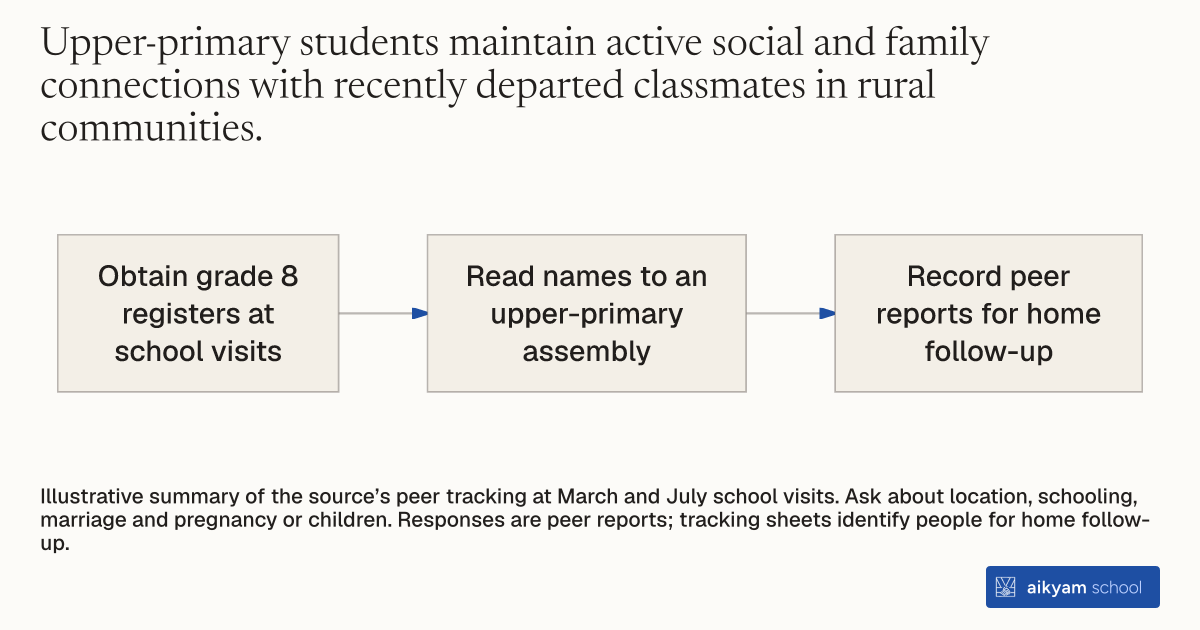
- Obtain grade 8 registers at school visits
- Read names to an upper-primary assembly
- Record peer reports for home follow-up
Illustrative summary of the source’s peer tracking at March and July school visits. Ask about location, schooling, marriage and pregnancy or children. Responses are peer reports; tracking sheets identify people for home follow-up.
See source →How
When to use
Tracking student behavioral outcomes like teen pregnancy or school dropout after primary school completion is difficult when adolescents scatter across rural communities. Researchers need a reliable tracking method to evaluate program impacts without conducting expensive door-to-door censuses. School assembly roll-calls use former classmates' collective knowledge to determine the whereabouts, childbearing status, and marriage status of past pupils.
Gather upper-primary students in school assemblies to verify the schooling, pregnancy, and marital status of former pupils using school registry rosters.
- Field enumerators visit primary schools in March and July following student graduation or primary exit.
- Enumerators obtain official grade 8 student registers from school administrators for the target evaluation cohort.
- Field workers convene an assembly of current pupils in upper-primary grades who are peers, siblings, or neighbors of former students.
- Enumerators read each former student's name aloud from the grade 8 register to the assembled student body.
- Field staff ask assembled pupils structured tracking questions regarding whether each named individual is still enrolled in school, where they live, whether they are married, and whether they are pregnant or have children.
- Enumerators record peer responses on standardized tracking sheets to identify target individuals requiring home follow-up visits.
Why it works
Using peer assemblies provides high accuracy and low attrition for tracking sensitive youth outcomes across widespread rural catchments.
Example
In 328 primary schools across Western Kenya, enumerators used peer assembly tracking in 2005 to track 13,016 former eighth-grade students. The method achieved an attrition rate under 2 percent and matched home interview verification results for 88 percent of reported pregnant girls and 92 percent of reported non-pregnant girls.
About the study
Participants
13,016 former grade 8 primary students (6,196 girls and 6,820 boys) across 328 primary schools in Western Kenya, with an average age of 15 years.
Study Design
A field tracking method conducted via two primary school visits in March and July 2005 comparing peer assembly reporting against direct home verification interviews on a subsample of 282 girls.
Results
Peer assembly tracking achieved an overall tracking rate with less than 2 percent attrition across 328 schools, yielding an 88 percent true positive rate for childbearing status and a 92 percent true negative rate when validated against direct home surveys.