Research design
Randomise schools for programme evaluation
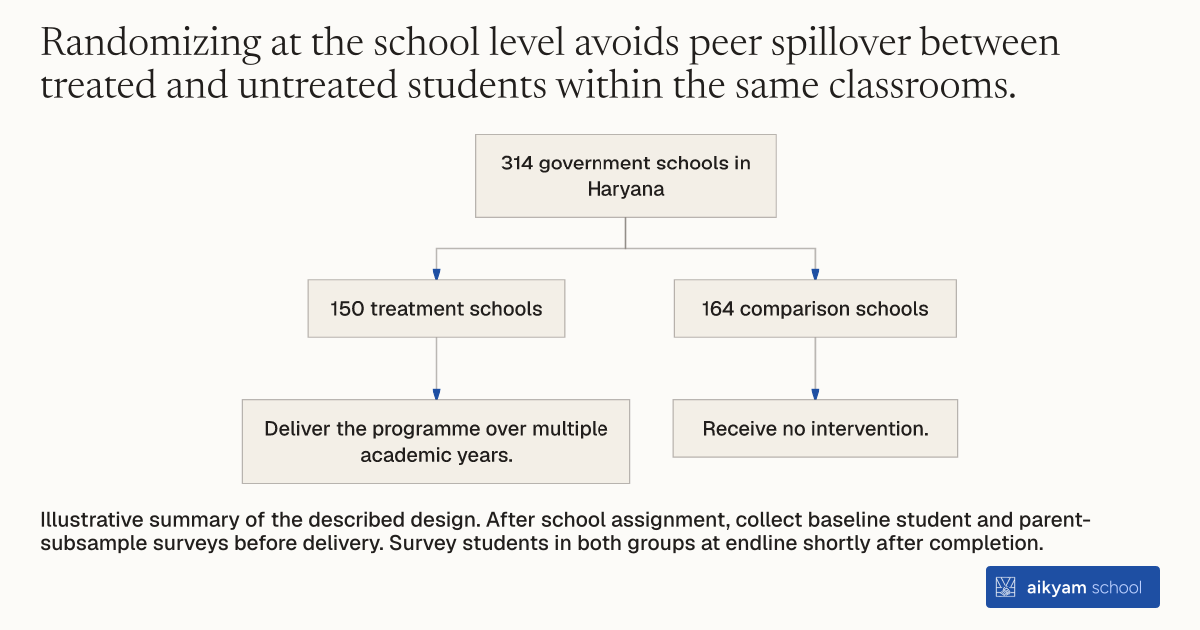
314 government schools in Haryana
- 150 treatment schools
- Deliver the programme over multiple academic years.
- 164 comparison schools
- Receive no intervention.
Illustrative summary of the described design. After school assignment, collect baseline student and parent-subsample surveys before delivery. Survey students in both groups at endline shortly after completion.
See source →How
When to use
Evaluating school-based social norm interventions requires rigorous experimental design to prevent cross-student contamination. This method measures the impact of attitude and behavior change programs across large public school networks. It serves researchers and evaluators assessing gender equity interventions in secondary schools.
Conduct a school-level cluster randomized controlled trial to measure program impacts on student attitudes, aspirations, and behaviors.
- Select a sample of public schools within a targeted geographical region.
- Stratify or randomly assign schools to either a treatment group receiving the program or a comparison group receiving no intervention.
- Administer baseline surveys to enrolled students prior to program implementation to capture initial attitudes and demographics.
- Survey a subsample of parents to assess baseline household background and parental gender views.
- Deliver the intervention in treatment schools over multiple academic years while leaving comparison schools unchanged.
- Administer endline surveys to students in all study schools shortly after program completion to measure post-intervention indices.
Why it works
Comparing treatment schools against control schools isolates the program's effect from outside social shifts and aging effects.
Example
Researchers evaluated Breakthrough's program across 314 government schools in Haryana, India, randomly assigning 150 schools to treatment and 164 to control. The evaluation showed the program increased the gender attitude index by 0.25 standard deviations and the behavior index by 0.32 standard deviations.
About the study
Participants
Nearly 15,000 students in grades 7–8 (aged 11–15) across 314 government schools in Haryana, India.
Study Design
School-level cluster randomized controlled trial comparing 150 treatment schools to 164 comparison schools with baseline and endline student surveys and a parental subsample survey.
Results
The evaluation found a 0.25 standard deviation increase in gender attitudes, a 0.32 standard deviation increase in gender behavior, a 12.9 percentage point increase in support for female employment, and an 8.4 percentage point increase in support for female higher education.