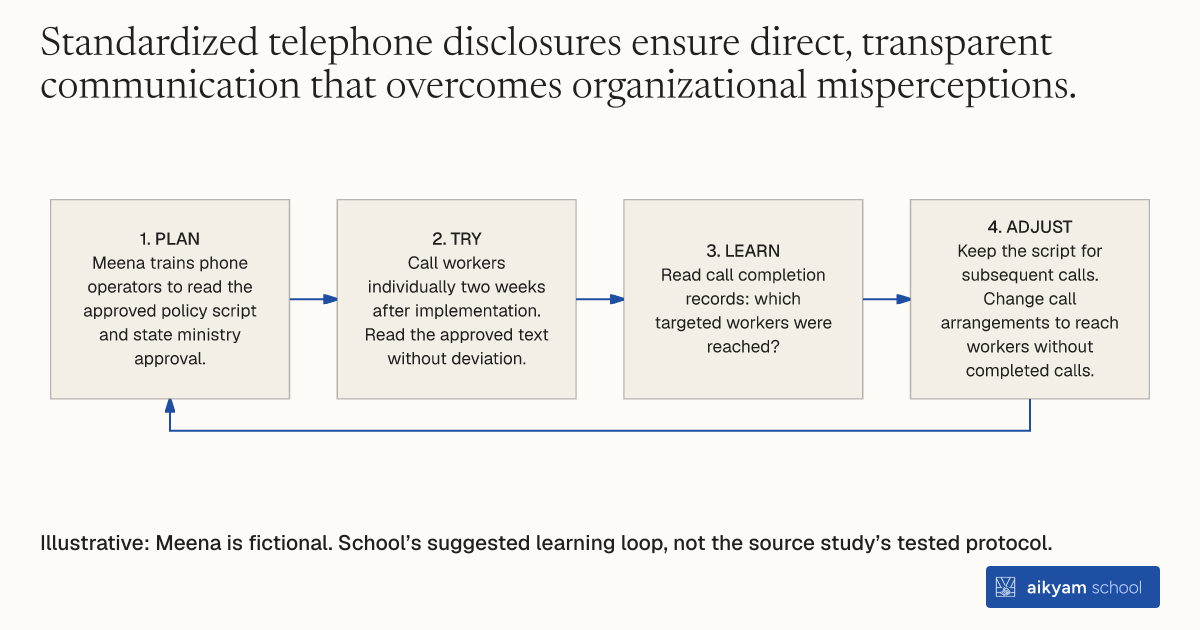
Try, learn and adjust
Check consistent promotion-policy calls
- Plan: Meena trains phone operators to read the approved policy script and state ministry approval.
- Try: Call workers individually two weeks after implementation. Read the approved text without deviation.
- Learn: Read call completion records: which targeted workers were reached?
- Adjust: Keep the script for subsequent calls. Change call arrangements to reach workers without completed calls.
Illustrative: Meena is fictional. School’s suggested learning loop, not the source study’s tested protocol.
See source →School’s suggested learning loop checks call coverage, separately from the study’s scripted policy communication.
How
When to use
Frontline public sector staff often hold inaccurate beliefs about institutional promotion rules and management practices. Distributing policy updates through official telephone calls ensures consistent policy messaging across remote healthcare units. Dedicated telephone operators read standardized scripts to inform individual healthcare workers about promotion criteria.
Deliver standardized policy messages to dispersed public sector workers using trained telephone operators reading approved scripts.
- Draft a concise script explaining official policy criteria and approval authority.
- Hire dedicated phone operators to deliver standardized spoken disclosures.
- Train phone operators to state upfront that national ministry authorities approved the message.
- Contact frontline health workers individually by telephone two weeks after policy implementation.
- Read the exact approved text aloud to each health worker without deviation.
- Record call completion to ensure uniform coverage across all targeted health facilities.
Why it works
Stating official ministry approval establishes high credibility and trust among frontline staff.
Example
In Sierra Leone, phone operators called 2,009 community health workers across 372 health posts to communicate promotion rules. Operators read a scripted text explaining that monthly service quantity and quality determine recommendations for supervisor positions in meritocratic posts. In control posts, operators read a script confirming that local facility managers nominate supervisors based on personal assessment.
About the study
Participants
2,009 Community Health Workers across 372 Peripheral Health Units in Sierra Leone.
Study Design
Randomized experiment evaluating belief updating two weeks after phone operators delivered standardized scripts.
Results
Delivering the scripted telephone message increased the proportion of health workers perceiving the promotion system as meritocratic by 28.4 percentage points (a 63% increase from 47.1% at baseline).