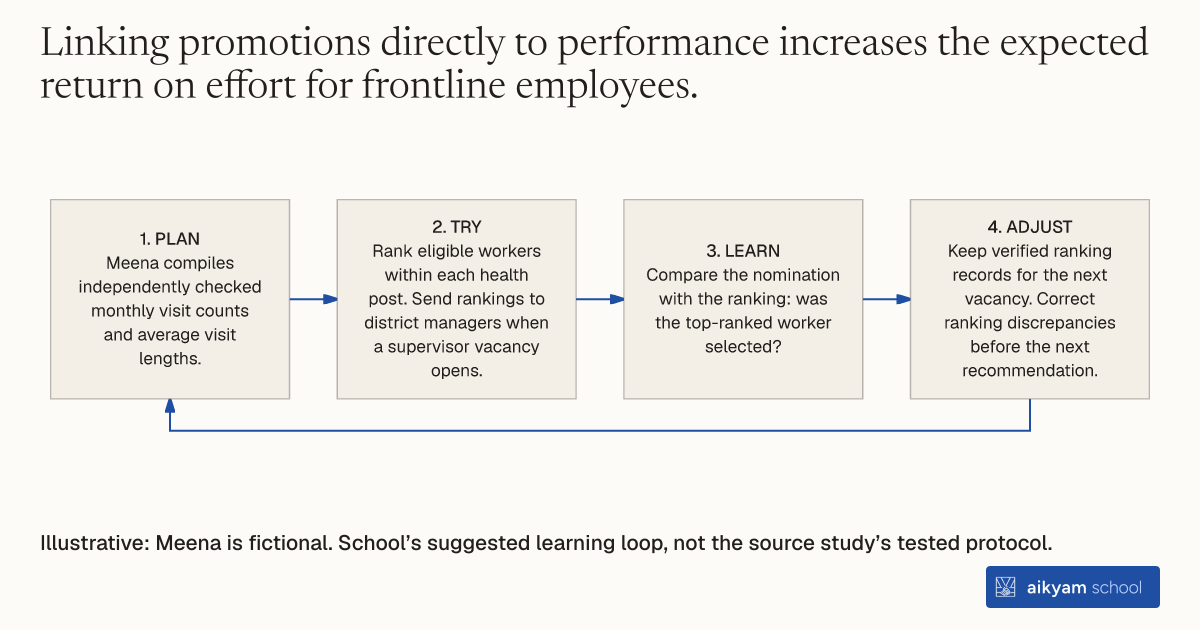
Try, learn and adjust
Check promotion rankings against verified performance
- Plan: Meena compiles independently checked monthly visit counts and average visit lengths.
- Try: Rank eligible workers within each health post. Send rankings to district managers when a supervisor vacancy opens.
- Learn: Compare the nomination with the ranking: was the top-ranked worker selected?
- Adjust: Keep verified ranking records for the next vacancy. Correct ranking discrepancies before the next recommendation.
Illustrative: Meena is fictional. School’s suggested learning loop, not the source study’s tested protocol.
See source →School’s suggested learning loop checks rankings and selection, separately from the tested promotion rule.
How
When to use
Public sector organizations often promote frontline workers using informal manager discretion rather than objective performance. This discretionary system breeds perceived favoritism and demotivates lower-tier employees. Setting clear, performance-based advancement rules restores motivation for frontline health workers competing for supervisory roles.
Select and promote frontline health personnel based strictly on verified service quantity and quality criteria rather than managerial discretion.
- Define objective performance criteria for promotion, focusing on monthly visit counts and average visit length.
- Collect field performance data across health units through independent household surveys and spot checks.
- Track vacancy openings among peer supervisor positions across health posts.
- Rank all eligible community health workers within a health post according to their audited performance data.
- Provide the performance rankings directly to district health management teams whenever a supervisor vacancy occurs.
- Nominate and promote the top-ranked worker to the open supervisor position.
Why it works
Workers increase daily service delivery to boost their rank in the promotion tournament.
Example
In Sierra Leone, the Ministry of Health and Sanitation transitioned 186 peripheral health units covering 2,009 community health workers to objective promotion rules. Researchers measured monthly visits and visit length over ten months, providing performance rankings to district managers when supervisor vacancies opened. District managers promoted top-performing workers, filling 4 vacancies in the meritocratic group.
About the study
Participants
2,009 Community Health Workers and 372 Peer Supervisors across 372 Peripheral Health Units in Sierra Leone.
Study Design
Randomized controlled trial across 372 Peripheral Health Units, evaluating CHW service delivery 10 months after introducing performance-based promotion criteria.
Results
Transitioning to meritocratic promotions increased the average number of household visits provided per worker by 22% (+1.497 visits) and increased average visit duration by 15%.