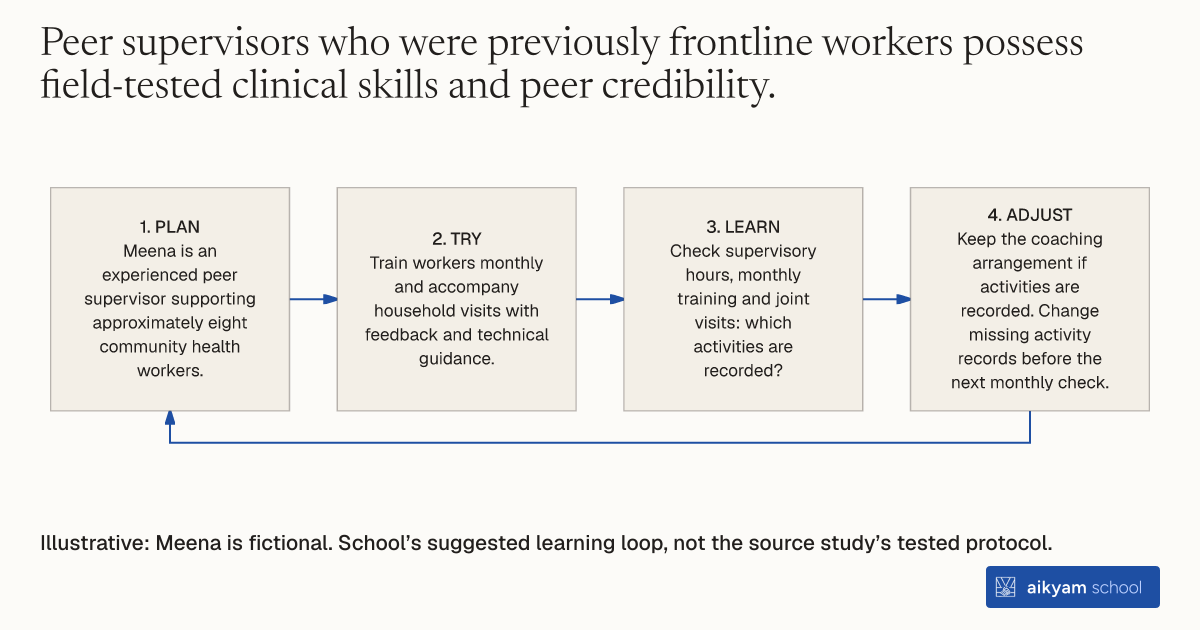
Try, learn and adjust
Check peer coaching and joint visits
- Plan: Meena is an experienced peer supervisor supporting approximately eight community health workers.
- Try: Train workers monthly and accompany household visits with feedback and technical guidance.
- Learn: Check supervisory hours, monthly training and joint visits: which activities are recorded?
- Adjust: Keep the coaching arrangement if activities are recorded. Change missing activity records before the next monthly check.
Illustrative: Meena is fictional. School’s suggested learning loop, not the source study’s tested protocol.
See source →School’s suggested learning loop checks supervisory activities, separately from the described coaching arrangement.
How
When to use
Frontline health personnel often enter community health roles without prior healthcare experience or formal medical training. Lack of ongoing field guidance and skills acquisition limits the clinical quality and consistency of community health services. Assigning peer supervisors to provide monthly training sessions and accompany frontline staff on household visits ensures continuous skill development.
Train and deploy peer supervisors to deliver monthly coaching sessions and conduct joint home visits with frontline health workers.
- Select peer supervisors who have prior experience and acquired health knowledge as community health workers.
- Assign one peer supervisor per peripheral health unit catchment area to oversee approximately eight community health workers.
- Conduct monthly training sessions for assigned frontline workers to build primary healthcare skills.
- Accompany frontline workers directly on household primary care visits to monitor service delivery.
- Provide real-time coaching, feedback, and technical guidance during joint home visits.
- Allocate roughly 11 hours per week to supervisory coaching, field visits, and administrative tasks.
Why it works
Joint visits and monthly coaching directly build health worker skills and maintain service quality.
Example
In Sierra Leone, 372 peer supervisors each supported an average of eight community health workers across 372 peripheral health units. Peer supervisors dedicated an average of 11.16 hours per week to training workers monthly and accompanying them on household primary care visits.
About the study
Participants
372 Peer Supervisors overseeing 2,009 Community Health Workers across 372 Peripheral Health Units in Sierra Leone.
Study Design
Field experiment tracking peer supervisor characteristics, hours worked, and supervisory activities at baseline and 10-month endline.
Results
Peer supervisors dedicated an average of 11.16 hours per week to supervisory duties, supporting frontline workers through monthly training and joint household visits.