Research procedure
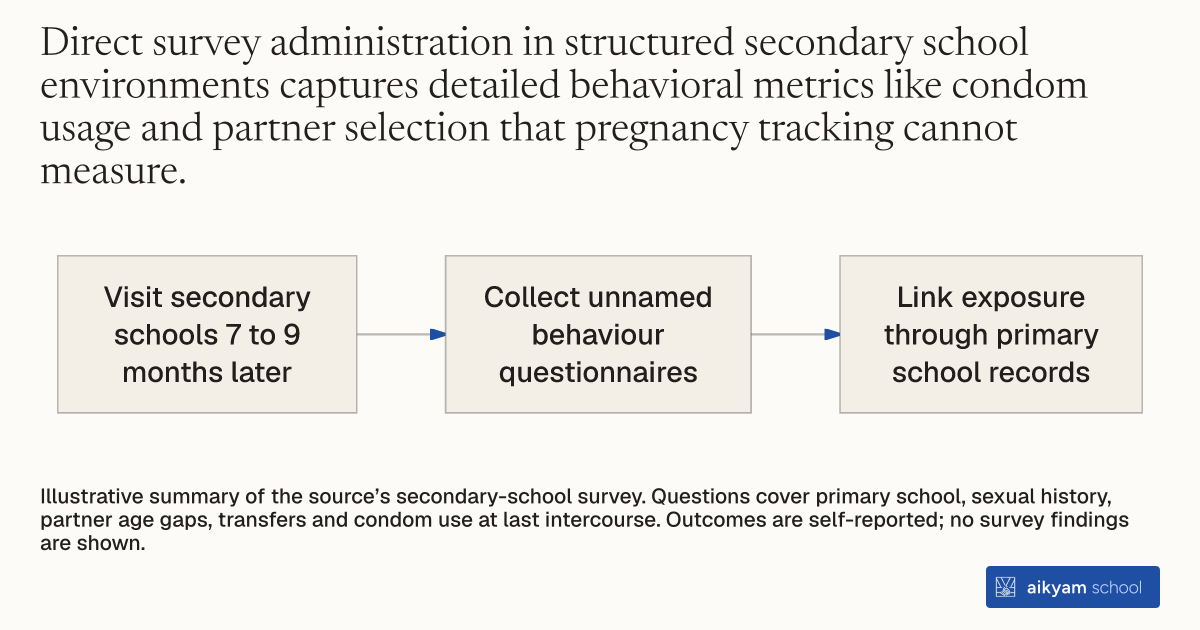
Collect anonymous behavioural follow-up
- Visit secondary schools 7 to 9 months later
- Collect unnamed behaviour questionnaires
- Link exposure through primary school records
Illustrative summary of the source’s secondary-school survey. Questions cover primary school, sexual history, partner age gaps, transfers and condom use at last intercourse. Outcomes are self-reported; no survey findings are shown.
See source →How
When to use
Self-reported sexual health behaviors like condom use and partner age gaps cannot be captured solely through biological proxies or peer assembly registers. Public health researchers need a direct survey method to evaluate how educational campaigns alter adolescents' specific intimate practices. Administering an anonymous questionnaire in secondary schools allows evaluators to collect detailed behavioral data from continuing students following primary school intervention exposure.
Administer an anonymous self-reported behavioral questionnaire to secondary school students to evaluate the long-term impact of primary health interventions on adolescent sexual activity.
- Enumerators visit secondary schools in the program catchment area seven to nine months following primary school intervention delivery.
- Field staff obtain administrative clearance and distribute self-administered paper questionnaires directly to enrolled secondary students.
- Students complete the survey anonymously without writing personal identifying names or signatures on the form.
- Survey items prompt respondents to detail their primary school of origin, sexual activity history, regular partner status, partner age gap, and financial transfers.
- Questionnaire questions measure specific risk reduction practices, including whether respondents used a condom during their last sexual intercourse.
- Field staff collect completed forms to match student treatment exposure via primary school records and evaluate behavioral mechanisms.
Why it works
Guaranteed anonymity reduces social desirability bias and encourages adolescent respondents to report sensitive sexual practices truthfully.
Example
Between May and July 2005, enumerators surveyed secondary school students across Western Kenya, including 2,173 girls and 2,678 boys linked to primary schools in the trial. The survey revealed that girls exposed to the relative risk campaign in eighth grade were 11.8 percentage points more likely to report using a condom at last sexual intercourse.
About the study
Participants
4,851 secondary school students (2,173 girls and 2,678 boys) across Western Kenya linked to 328 primary schools in the study sample.
Study Design
A secondary school behavioral follow-up survey administered 7 to 9 months post-treatment to evaluate self-reported sexual activity, partner age gaps, and condom use across treatment and control primary school cohorts.
Results
Exposure to the relative risk campaign increased girls' condom use at last intercourse by 11.8 percentage points (a 32 percent increase off a 36 percent control baseline) and reduced regular partners over 5 years older to near zero, while increasing boys' reported sexual activity by 12.5 percentage points.