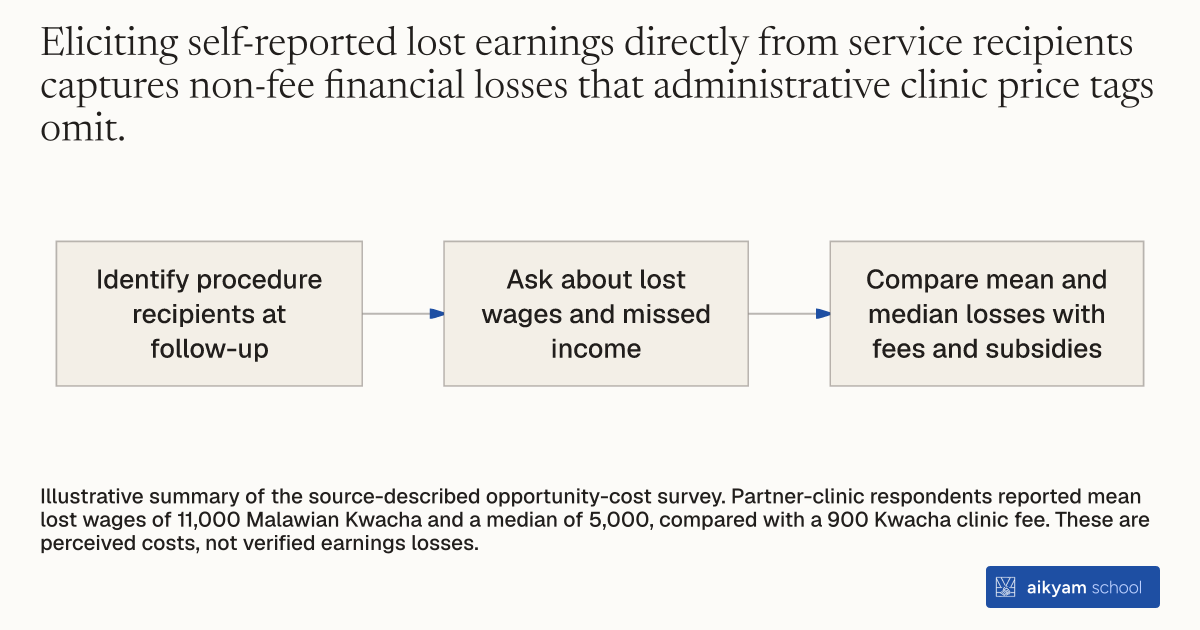
Research steps
Measure reported income lost during recovery
- Identify procedure recipients at follow-up
- Ask about lost wages and missed income
- Compare mean and median losses with fees and subsidies
Illustrative summary of the source-described opportunity-cost survey. Partner-clinic respondents reported mean lost wages of 11,000 Malawian Kwacha and a median of 5,000, compared with a 900 Kwacha clinic fee. These are perceived costs, not verified earnings losses.
See source →How
When to use
In health economics and project budgeting, monetary price subsidies cover direct clinical fees but ignore indirect economic losses such as missed work time and lost income. Project planners need to quantify indirect economic costs to understand non-fee financial barriers facing low-income participants. This method asks post-procedure clients to report lost income to evaluate total financial barriers to service adoption.
Assess indirect financial barriers by surveying individuals after medical procedures about income lost during surgical recovery.
- Identify respondents who completed a voluntary medical procedure during post-intervention follow-up interviews.
- Ask respondents to estimate total lost wages and missed income resulting from the surgery and post-operative recovery period.
- Calculate mean and median perceived opportunity costs across all treated individuals.
- Compare reported opportunity costs against initial fee structures and subsidy voucher amounts to determine relative financial barriers.
Why it works
Measuring median opportunity costs reveals whether indirect wage losses outweigh direct surgical fees in client decision-making.
Example
In Lilongwe, Malawi, researchers asked men who received circumcisions to report lost wages from surgery and recovery. Men circumcised at the partner clinic reported an average opportunity cost of 11,000 Malawian Kwacha (US$73) with a median of 5,000 Malawian Kwacha (US$33), far exceeding the 900 Kwacha clinic fee.
About the study
Participants
43 men circumcised at the partner clinic (and expanded sample of 111 total circumcised men) in Lilongwe, Malawi.
Study Design
Post-procedure survey elicitation of lost wages among circumcised respondents during 12-month panel follow-up interviews.
Results
Partner clinic patients reported average lost wages of 11,000 Malawian Kwacha (US$73); expanding to all circumcised men yielded an average of 14,720 Malawian Kwacha (US$98), with a median of 5,000 Malawian Kwacha (US$33) in both groups.