Try, learn and adjust
Check household hygiene facilities and well upkeep
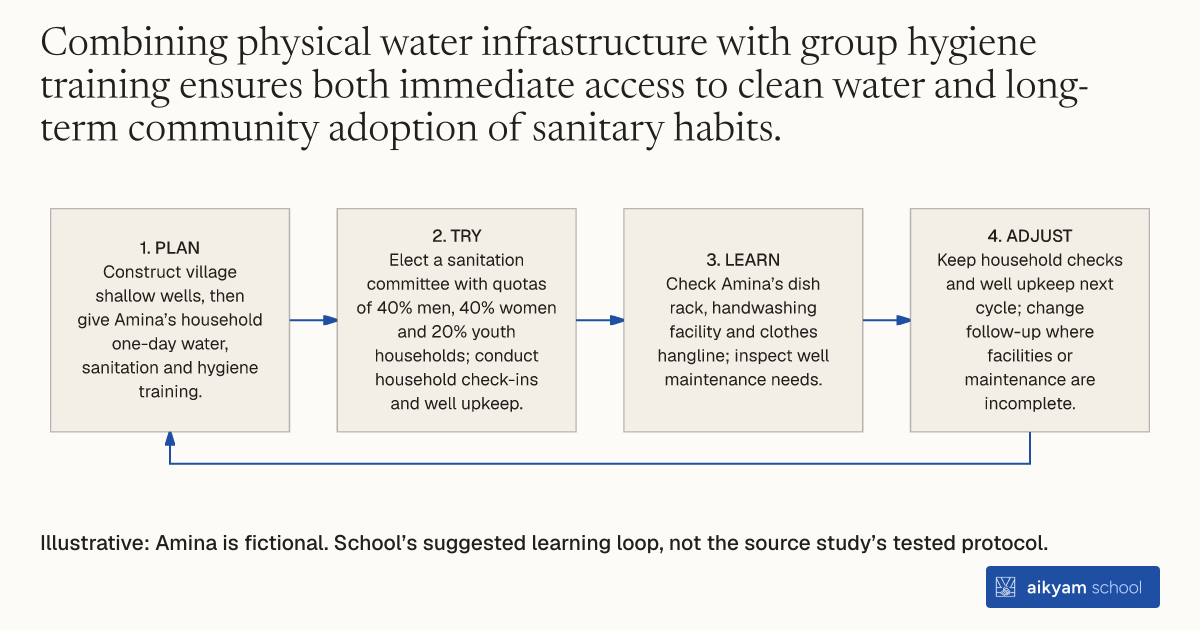
- Plan: Construct village shallow wells, then give Amina’s household one-day water, sanitation and hygiene training.
- Try: Elect a sanitation committee with quotas of 40% men, 40% women and 20% youth households; conduct household check-ins and well upkeep.
- Learn: Check Amina’s dish rack, handwashing facility and clothes hangline; inspect well maintenance needs.
- Adjust: Keep household checks and well upkeep next cycle; change follow-up where facilities or maintenance are incomplete.
Illustrative: Amina is fictional. School’s suggested learning loop, not the source study’s tested protocol.
See source →School’s suggested, untested learning loop. Observe household facilities and well inspections. The source calls check-ins bi-weekly; this suggested loop does not specify a different frequency or establish health effects.
How
When to use
Rural communities in low-income regions often lack clean drinking water and basic sanitation facilities, leading to high rates of waterborne illness. Constructing village water infrastructure combined with community hygiene training provides clean water access and promotes healthy household practices. This approach is intended for rural villages experiencing frequent sickness and poor sanitation infrastructure.
Construct shallow wells and deliver community hygiene training to improve water access and sanitation practices across rural villages.
- Construct shallow wells within the village to supply clean drinking water to every household.
- Deliver a one-day Water, Sanitation, and Hygiene training session instructing households on essential hygiene practices, such as installing handwashing stations outside toilets.
- Form an elected volunteer sanitation committee with demographic quotas of 40% men, 40% women, and 20% youth households.
- Conduct bi-weekly household check-ins through the sanitation committee to verify that families install dish racks, handwashing facilities, and clothes hanglines.
- Maintain community shallow wells through regular inspections and upkeep by the village sanitation committee.
Why it works
Bi-weekly peer check-ins keep households accountable for maintaining clean living environments and reducing disease vectors.
Example
In rural western Uganda, Raising the Village constructed shallow wells and delivered one-day WASH trainings across treated villages, increasing the health improvement index by 0.389 standard deviations and reducing child illness.
About the study
Participants
3,852 households across 335 villages in Kagadi and Kyenjojo districts, western Uganda, where 35% of households fall below the $2.15 PPP daily poverty line post-harvest and 65% during the lean season.
Study Design
Clustered randomized controlled trial across 114 village clusters covering 335 villages, comparing a universal livelihoods program to a pure control group.
Results
97% of chairpersons in treated villages reported well construction, the health improvement index rose by 0.389 standard deviations (p < 0.01), handwashing facilities outside toilets increased by 26.7 percentage points (p < 0.01), two-tiered dish racks increased by 32.5 percentage points (p < 0.01), and child illness dropped by 4.1 percentage points (p < 0.05).