Try, learn and adjust
Check ordered water reaches the home
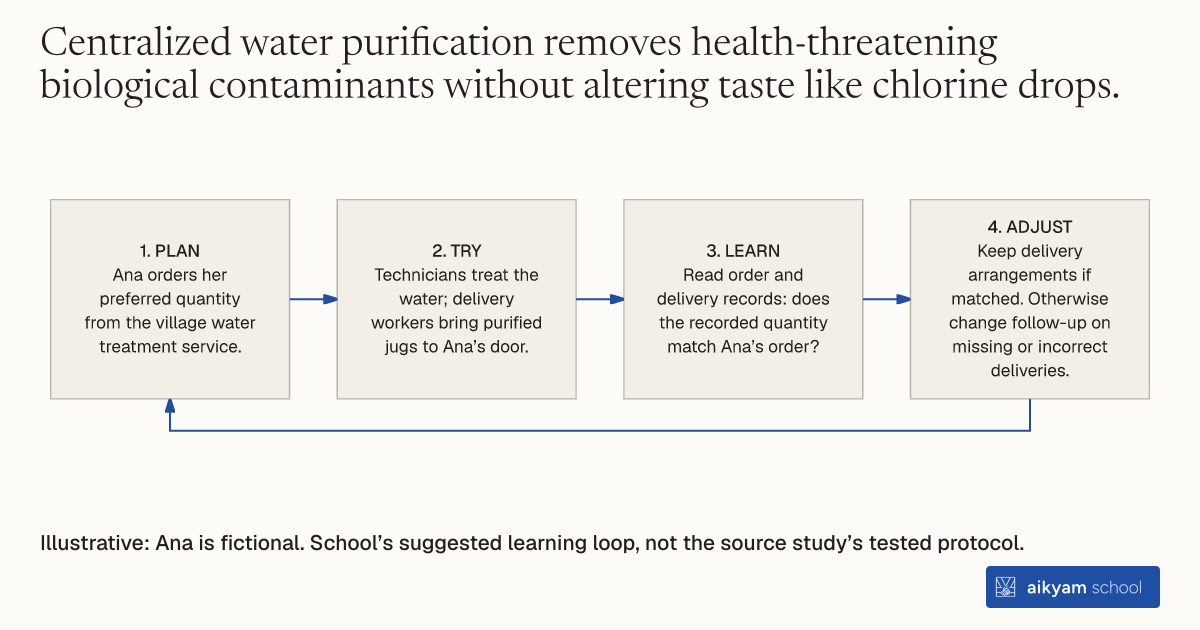
- Plan: Ana orders her preferred quantity from the village water treatment service.
- Try: Technicians treat the water; delivery workers bring purified jugs to Ana’s door.
- Learn: Read order and delivery records: does the recorded quantity match Ana’s order?
- Adjust: Keep delivery arrangements if matched. Otherwise change follow-up on missing or incorrect deliveries.
Illustrative: Ana is fictional. School’s suggested learning loop, not the source study’s tested protocol.
See source →School’s suggested learning loop: observe treatment, orders and delivery records; this loop does not verify individual health effects.
How
When to use
Rural households in low-income regions lack clean drinking water and spend significant time hauling contaminated water. Point-of-use chlorine drops face poor adoption, while piped water networks are prohibitively expensive to build. Direct home delivery of purified water serves rural families needing safe water without heavy collection burdens.
Deliver purified drinking water directly to rural homes using local village processing centers.
- Spring Health builds water treatment facilities inside local villages to process surface or groundwater.
- Technicians treat the water to remove harmful bacteria and biological contaminants.
- Households submit water orders directly to Spring Health for their preferred quantity.
- Delivery workers transport the purified water jugs directly to the household doorway.
- Staff record administrative order data to manage recurring deliveries and inventory.
Why it works
Delivering directly to the doorstep eliminates the heavy physical labor and time required for daily water collection.
Example
Spring Health delivered purified water directly to rural families in 120 intervention villages in Odisha, India. Participating households cut their daily water collection time by 15 to 39 percent and reduced sickness by 22 percent.
About the study
Participants
60,000 households across 160 villages in rural Odisha, India, with an average household size of five members and median bank balance of INR 2,000.
Study Design
Randomized controlled trial dividing 160 villages into four equal groups of 40 villages each, evaluating water delivery under priced, free, exchangeable entitlement, and comparison conditions.
Results
Offering priced water delivery reduced instances of sickness by 22 percent, while water collection time fell by 15 to 39 percent compared to the 32-minute comparison group baseline.