Try, learn and adjust
Check shop commissions and salt availability
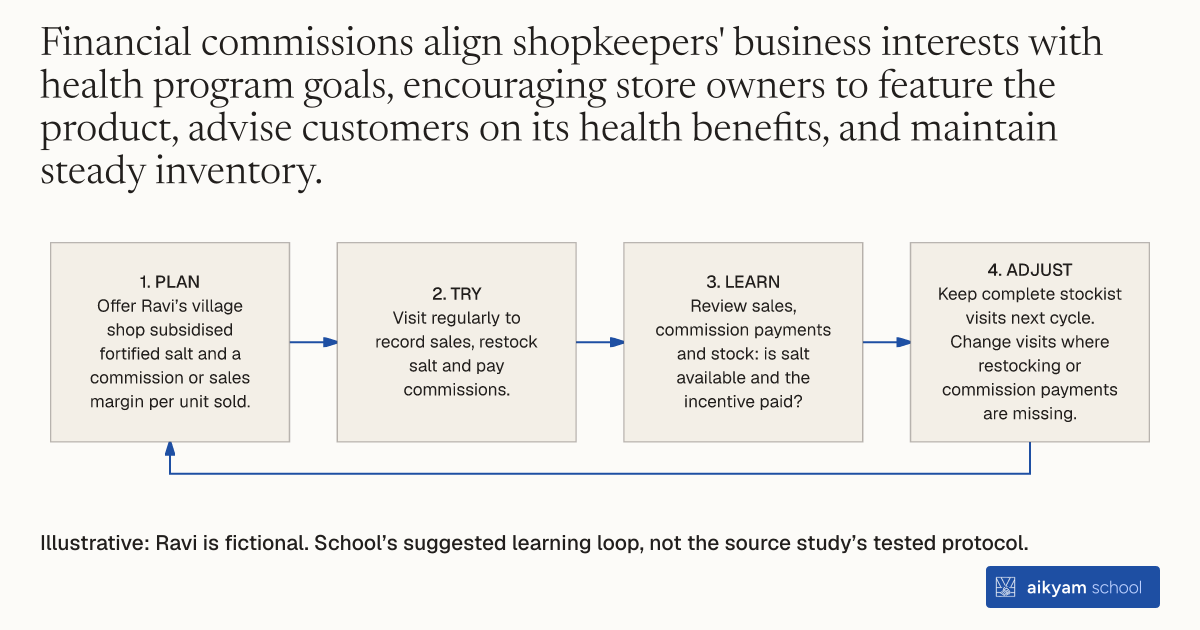
- Plan: Offer Ravi’s village shop subsidised fortified salt and a commission or sales margin per unit sold.
- Try: Visit regularly to record sales, restock salt and pay commissions.
- Learn: Review sales, commission payments and stock: is salt available and the incentive paid?
- Adjust: Keep complete stockist visits next cycle. Change visits where restocking or commission payments are missing.
Illustrative: Ravi is fictional. School’s suggested learning loop, not the source study’s tested protocol.
See source →School’s suggested, untested loop. Observe sales, stocking and commissions; do not infer a health effect from retailer incentives alone.
How
When to use
In rural markets, store owners have little financial motivation to stock, display, or actively recommend new health products over established brands with existing customer demand. When public health initiatives rely on private retail networks to sell subsidized fortified food, shopkeeper apathy can lead to low inventory and weak sales. Providing financial commissions to local grocery store owners encourages shopkeepers to actively market and stock new health products.
Provide financial incentives to local retail shopkeepers to encourage active sales and stocking of new health products.
- Identify all local kirana grocery shops and Public Distribution System outlets serving targeted rural villages.
- Offer shopkeepers the option to stock the health product at a subsidized wholesale rate.
- Establish a monetary commission or sales margin paid directly to shopkeepers for each unit of the health product sold.
- Deploy stockist sales teams to visit village shops regularly to record sales volumes, restock products, and pay commissions.
- Monitor shopkeeper stocking and sales activity over the project period to ensure product availability across villages.
Example
In a social marketing experiment embedded within the Bihar salt evaluation across rural villages, researchers provided shopkeeper incentives to sell double-fortified salt. In villages where shopkeepers received sales incentives, current double-fortified salt usage increased by approximately 5 percentage points compared to standard sales villages.
About the study
Participants
Sub-experiment within 200 sales villages in Bhojpur district, Bihar, evaluating household adoption across rural communities with a 45 percent baseline anemia rate.
Study Design
Cross-randomized intervention within a cluster randomized trial where shopkeeper incentives were randomly assigned to a subset of sales villages to test effects on product adoption compared to standard retail availability.
Results
Shopkeeper sales incentives induced higher product take-up, increasing current double-fortified salt usage by about 5 percentage points, though this increased take-up was insufficient to generate significant overall improvements in population hemoglobin concentration or anemia by endline.