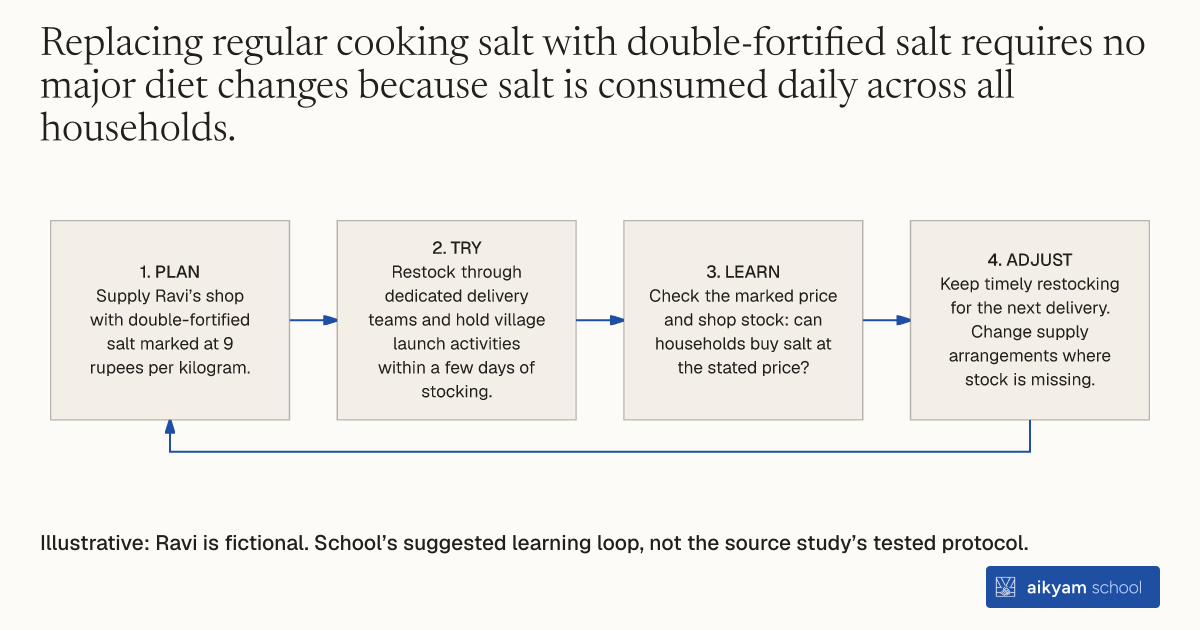
Try, learn and adjust
Check subsidised salt stays available
- Plan: Supply Ravi’s shop with double-fortified salt marked at 9 rupees per kilogram.
- Try: Restock through dedicated delivery teams and hold village launch activities within a few days of stocking.
- Learn: Check the marked price and shop stock: can households buy salt at the stated price?
- Adjust: Keep timely restocking for the next delivery. Change supply arrangements where stock is missing.
Illustrative: Ravi is fictional. School’s suggested learning loop, not the source study’s tested protocol.
See source →School’s suggested, untested loop. Observe price and availability during the roughly 30-month supply period. Salt contains 1 mg iron and 40 micrograms iodine per gram; delivery does not establish health benefits.
How
When to use
Poor households in rural areas suffer from iron deficiency anemia because diets lack animal protein. Public health programs struggle to deliver daily iron supplements reliably across entire populations. Subsidized retail sales introduce iron-fortified salt into local village shops at a lower price so households can buy it through normal market channels.
Sell double-fortified salt containing iron and iodine through local village shops at a subsidized retail price.
- Partner with a commercial salt manufacturer to produce double-fortified salt containing 1 mg of iron and 40 micrograms of iodine per gram of salt.
- Package the salt with a special subsidized maximum retail price of 9 rupees per kilogram, marked directly on the packet.
- Offer stock of the double-fortified salt to all kirana grocery shops and Public Distribution System shops serving targeted rural villages.
- Deploy stockists and dedicated delivery teams to take orders from village shopkeepers and restock salt supplies over a 30-month period.
- Conduct initial village launch activities with marketing teams who perform street plays and games about anemia awareness in central locations within a few days of stocking shops.
Why it works
Providing a 50 percent price discount lowers financial barriers to purchase while using existing village shop networks ensures local product availability.
Example
Researchers and Tata Chemicals Limited introduced double-fortified salt priced at 9 rupees per kilogram across 200 rural villages in Bhojpur district, Bihar. Over 23 months, 42.6 percent of households tried the salt at least once, and 14.5 percent were using it at endline.
About the study
Participants
200 treatment villages and 200 control villages in Bhojpur district, Bihar, comprising 6,000 baseline households with an average age of 28 years and a 45 percent baseline anemia rate.
Study Design
Cluster randomized controlled trial with 200 villages assigned to retail DFS sales at 9 rupees per kg and 200 control villages without sales over nearly 30 months, evaluating hemoglobin levels via HemoCue blood testing.
Results
The sales treatment increased hemoglobin by an statistically insignificant 0.033 g/dL (95% CI: -0.024 to +0.09 g/dL) and reduced anemia prevalence by an insignificant 0.6 percentage points across the general population.