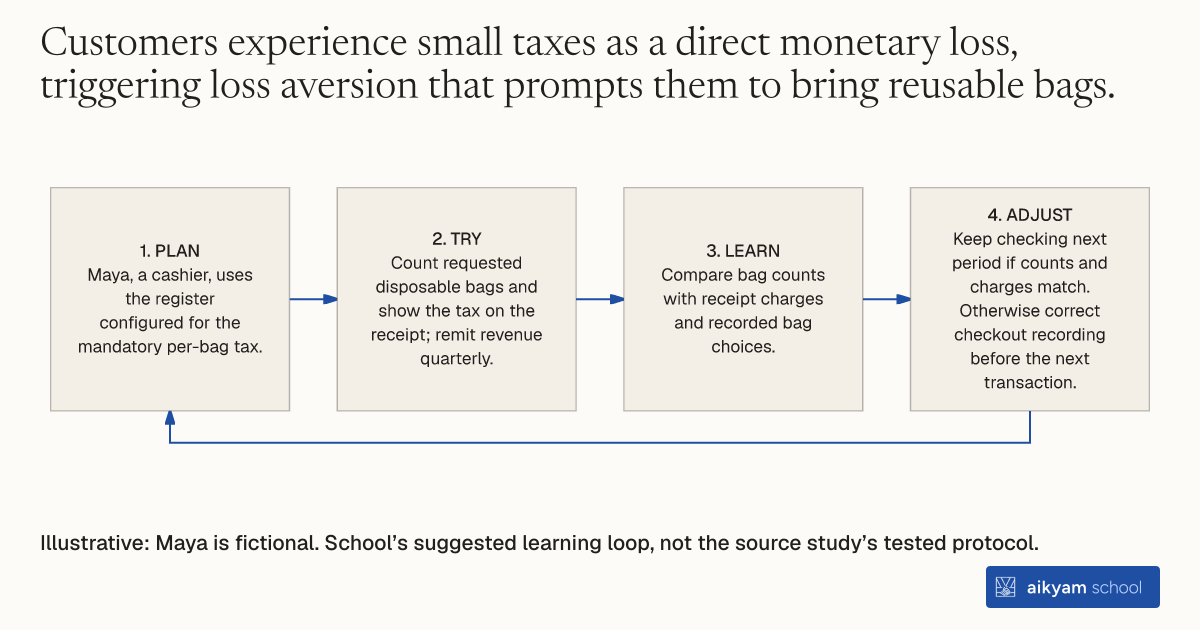
Try, learn and adjust
Check bag taxes at checkout
- Plan: Maya, a cashier, uses the register configured for the mandatory per-bag tax.
- Try: Count requested disposable bags and show the tax on the receipt; remit revenue quarterly.
- Learn: Compare bag counts with receipt charges and recorded bag choices.
- Adjust: Keep checking next period if counts and charges match. Otherwise correct checkout recording before the next transaction.
Illustrative: Maya is fictional. School’s suggested learning loop, not the source study’s tested protocol.
See source →School’s suggested, untested learning loop. Observe disposable bag counts, receipt charges and reusable bag choices.
How
When to use
Voluntary reusable bag bonus rewards fail to reduce single-use plastic bag consumption among grocery store shoppers. Financial penalties leverage loss aversion to change consumer carryout bag behavior. Municipalities need effective point-of-sale policy mechanisms to decrease plastic bag waste.
Charge retail grocery store customers a mandatory per-bag tax on single-use disposable plastic carryout bags at register checkout.
- Municipal authorities pass an ordinance mandating a per-bag tax on single-use plastic bags across retail grocery stores.
- Retail grocery management updates checkout point-of-sale register software to automatically apply the per-bag tax item charge.
- Cashiers record the exact count of single-use disposable bags requested by shoppers during checkout transactions.
- Point-of-sale systems display the total plastic bag tax amount explicitly on customer purchase receipts.
- Retailers remit collected bag tax revenue to municipal environmental enforcement departments on a quarterly schedule.
Why it works
Conversely, financially equal bonus incentives are perceived as minor optional rewards that fail to motivate behavioral change.
Example
In Montgomery County, Maryland, a five-cent tax on disposable plastic bags reduced the probability of using a disposable plastic bag by over 40 percentage points, whereas a financially equivalent five-cent reusable bag bonus had no effect on bag usage.
About the study
Participants
Grocery store shoppers across Montgomery County, Maryland, Washington D.C., California, and Chicago.
Study Design
Quasi-experimental natural field experiment comparing consumer retail bag choices before and after tax implementation versus bonus rewards.
Results
Disposable bag taxes decreased the likelihood of using a disposable plastic bag by over 40 percentage points and increased reusable bag usage, whereas financially equal 5-cent reusable bag bonus rewards produced zero statistically detectable change in bag usage.