Research procedure
Track referrals from workplace contacts
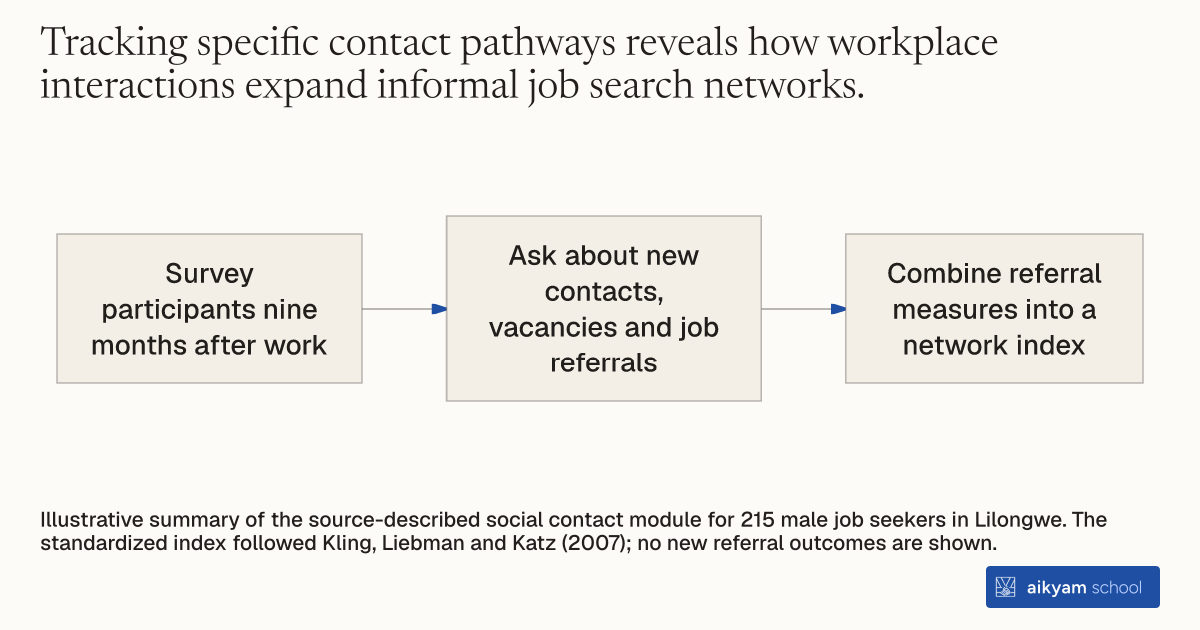
- Survey participants nine months after work
- Ask about new contacts, vacancies and job referrals
- Combine referral measures into a network index
Illustrative summary of the source-described social contact module for 215 male job seekers in Lilongwe. The standardized index followed Kling, Liebman and Katz (2007); no new referral outcomes are shown.
See source →How
When to use
Evaluators measuring employment program mechanisms often do not know whether post-program wage gains stem from formal skills or expanded peer connections. Administering a dedicated social contact survey module tracks whether participants hear about unadvertised job vacancies through contacts met during workplace assignments. This method serves researchers evaluating mechanisms behind active labor market interventions.
Measure workplace social network expansion using structured job referral survey modules.
- Administer a follow-up survey module to participants several months after completing temporary employment.
- Ask respondents whether they met new professional contacts during their recent workplace placement.
- Record whether respondents heard about new job opportunities through contacts met during the work assignment.
- Document whether respondents secured post-intervention employment through direct referrals from these new connections.
- Aggregate individual referral metrics into a standardized social network index following Kling, Liebman, and Katz (2007).
Why it works
Connecting with peers and supervisors reduces search costs by granting early access to unadvertised job opportunities.
Example
A research team in Lilongwe, Malawi surveyed 215 male job seekers 9 months after a short-term work intervention. The team administered a social contact module asking participants about contacts met during the project and tracked subsequent job referral outcomes.
About the study
Participants
215 urban male youth job seekers in Lilongwe, Malawi, interviewed 9 months after intervention completion.
Study Design
Instrumental Variable (IV) estimation evaluating job referral measures and a standardized social network index constructed following Kling, Liebman, and Katz (2007).
Results
Short-term work experience increased the probability of hearing about a work opportunity through project contacts by 22.2 percentage points (p < 0.05) and increased the standardized social network index by 0.306 standard deviations (p < 0.10).